
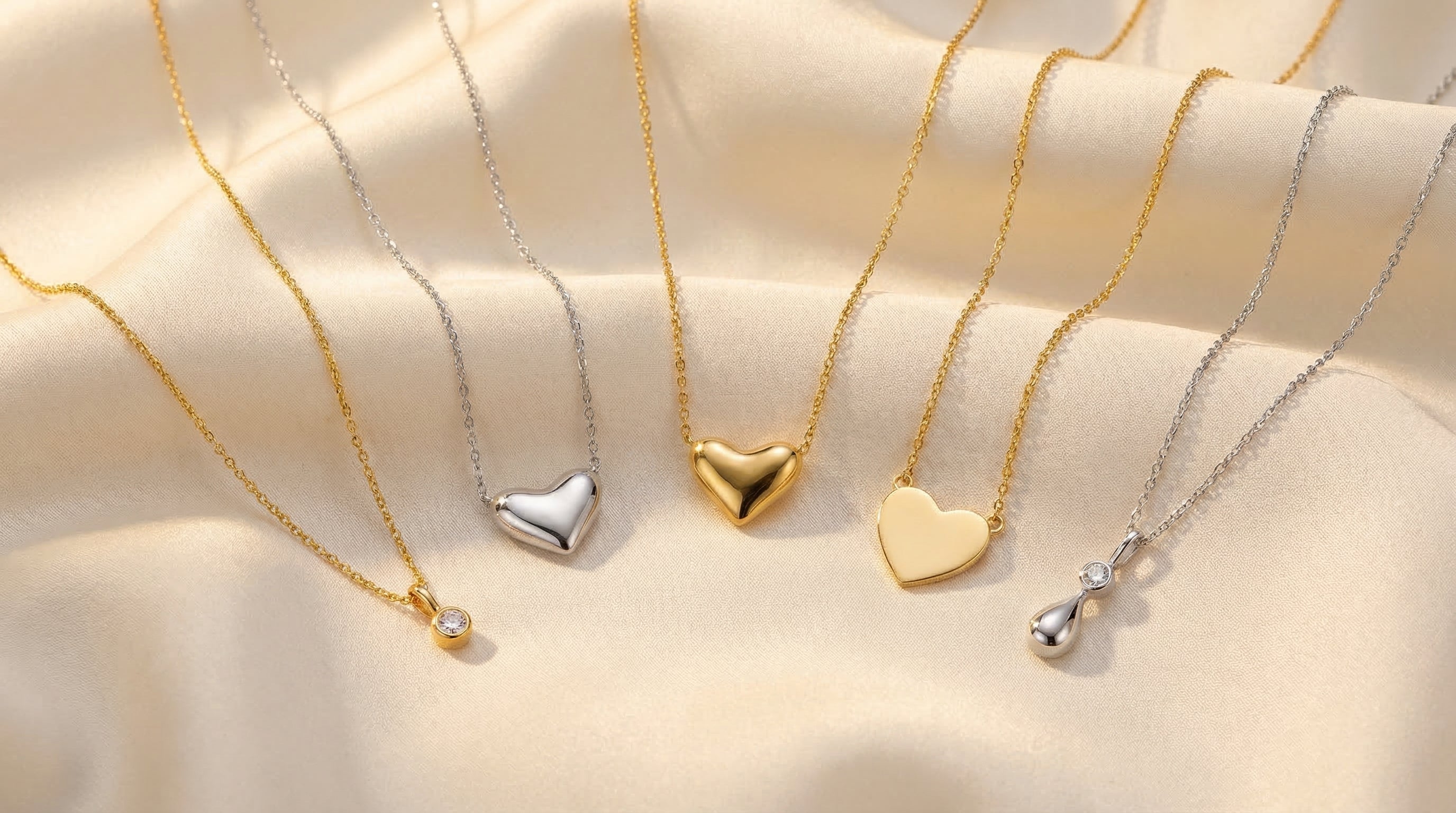
Flip a necklace over before you fall in love with it. On a genuine solid-gold piece, the tiny stamp reading 14K or 585 usually sits on the clasp tongue or on the small oval tag soldered beside it. That stamp is the single fastest way to separate a necklace that will still look like gold in fifteen years from one that is gold-colored today and copper-colored by her next birthday. It is also the detail most product pages leave out, which is exactly why so many well-meant gifts for mom end up disappointing.
This guide is written for the person searching for a mom necklace in 14k gold with a card already picked out. It covers what the karat number actually buys you, how solid gold compares with vermeil and plating, how to choose a length and clasp that match how she really wears jewelry, and which personalized styles — birthstones, initials, names, moissanite — suit which kind of mother. Where the evidence on pricing is inconsistent, we say so rather than quote a number that will be wrong by the time you read this.
Start With the Hallmark: What 14K Gold Actually Means
Pure gold is 24 karat, and it is too soft to survive being worn on a body that lifts, cooks, hugs, and sleeps. Jewelry gold is therefore alloyed. A 14K piece is roughly 58.3% pure gold blended with about 41.7% other metals — typically copper, silver, zinc, or palladium. That alloy content is not a compromise; it is the reason a 14K chain link, jump ring, and clasp can take years of friction without deforming.
14K vs. 18K for a necklace she'll wear daily
18K gold contains about 75% pure gold and reads slightly warmer and richer in color. It is also softer. For a pendant necklace that rubs against collars, seatbelts, and skin every day, 14K's greater hardness and scratch resistance is the practical choice, which is why it dominates the everyday fine-jewelry category. Choose 18K when the piece is occasional-wear and the deeper yellow tone matters more than surface durability; choose 14K when you want her to put it on and forget about it.
Solid 14K gold vs. gold vermeil vs. gold plated
These three phrases are used almost interchangeably in marketing copy, and they describe very different products:
- Solid 14K gold. The alloy runs all the way through the metal. It resists tarnishing and corrosion, and there is no coating to wear off. This is the tier that realistically becomes an heirloom.
- Gold vermeil. A thick layer of gold — commonly around 2.5 microns — bonded over a sterling silver base. Because the base metal is precious rather than brass, vermeil is markedly more durable than plating and a legitimate choice, but the gold layer can still wear with time and it wants gentler care.
- Gold plated. A thin electroplated film of gold over brass or copper. It looks convincing on day one. As the plating wears, the base metal shows through, and the fix is replating rather than repair.
None of these is dishonest in itself. The problem is buying one while believing you bought another. If a listing says only "14K gold finish," "14K gold over…," or "gold tone," it is not solid gold.
How to verify before you check out
Hallmarking exists precisely so buyers do not have to take a seller's word for metal content. In practice, do three things:
- Look for the stamp in the photos. A macro shot of the clasp or tag showing 14K or 585 is a strong signal. If the stamp is nowhere in eight product images, ask for it.
- Ask the direct question. "Is this solid 14K gold or gold plated, and what is the base metal?" A confident answer is normal; a vague one is your answer.
- Ask about stones separately. Metal hallmarks say nothing about gemstones. For pieces with meaningful diamond content, independent gemological documentation is the equivalent trust signal.
You can browse everything we make in genuine solid gold in the solid gold pieces collection, where the metal is stated rather than implied.
Read Her Jewelry Dish Before You Read Product Pages
The most expensive necklace mistake is not overpaying — it is buying beautifully and buying wrong. Jewelry that does not match a recipient's habits simply stays in the box. Spend five minutes with whatever dish, tray, or tangle of chains she keeps by the sink, and you will learn more than an hour of scrolling.
Metal tone: follow her, not the trend
If everything in the dish is white metal, a yellow gold pendant will feel foreign no matter how fine it is. Note her earrings and her watch too — those get worn most consistently. Mixed metals are increasingly normal, but a mom who has worn silver for thirty years usually wants silver. That is not a downgrade: a sterling piece she wears weekly beats a gold piece she admires and never puts on.
Chain length, and why 18 inches is the safe default
Length decides whether a pendant lands where she can see it or disappears into a neckline. Practical rules for adult women:
- 16 inches sits at the base of the throat — flattering with open necklines, and the choice for someone who likes jewelry high and visible.
- 18 inches falls just below the collarbone. It is the most forgiving length for a single pendant and the safest gift default.
- 20 inches and longer sits on the sternum, works over sweaters and layered looks, and gives a larger pendant room to hang correctly.
If she already layers, check the lengths she owns and choose something at least two inches different so the new piece nests instead of fighting. An adjustable chain with sliding extender links removes the guesswork entirely, and adjustability measurably raises the odds a gift actually gets worn.
Clasp, weight, and her actual day
A mother of a toddler, a nurse on twelve-hour shifts, and a mom who wears jewelry mainly to dinner need different hardware. Spring rings are slim and discreet; lobster clasps are easier to operate one-handed and grip more securely under movement. Heavier pendants need a chain gauge that can carry them — a hair-thin cable chain under a substantial locket is a repair waiting to happen. If arthritis or dexterity is a factor, a larger lobster clasp or a magnetic-assisted closure is a genuine kindness.
Gift Picks: Matching the Necklace to the Message
Personalization is where mom necklaces stop being jewelry and start being a record of a family. Below, picks organized by the mother rather than by the metal.
For the mom who wears one necklace every single day
Buy solid gold and buy a shape she can wear with anything. A heart is the least ambiguous symbol available and it does not date. The Affection Heart Necklace is a 14K gold heart design built for exactly this brief: one pendant, on all the time, with no plating to babysit. If you want to compare silhouettes side by side, the wider heart necklaces collection shows how proportion changes the feel — a small heart reads delicate and modern, a fuller heart reads classic and sentimental.
For the mom who tears up at baby photos: birthstone hearts
Birthstones turn a pendant into a roll call. Two children, two stones, one heart — worn where she can look down at it. Beautiful Mom | Custom 2 Birthstones Heart Necklace (from daughter) and the matching from son version let the card's voice match the giver. For three or more children, spacing and stone size matter more than most listings admit; our guide to a birthstone necklace with 3 stones covers how to keep a multi-stone pendant balanced rather than crowded, and the broader roundup of birthstone necklaces for mom compares layouts from single-stone to full family clusters.
One durability note worth knowing: some natural birthstones — emerald, opal, pearl — are considerably softer and more fragile than others, so they need protective settings and gentler wear. Lab-created equivalents of the same colors are a reasonable substitution for a piece intended for daily use.
For the minimalist: initials and single letters
If her whole aesthetic is "one small thing," a single letter in solid gold outperforms any elaborate pendant. Initials also scale well: one letter for her own name, or a set of small letters for each child on a fine chain. Our 14K gold initial necklace guide walks through script versus block letterforms, and why letter height rather than chain length determines whether a monogram reads as elegant or as a keyring charm.
For names and dates: engraving that stays legible
"Mother's necklace with names" is one of the most common searches in this category, and the most common regret is over-filling. Engraving depth and font both wear over years of skin contact, and very fine script on a curved surface loses definition first. Keep engraved pieces to a short list — names, or a single date — on a flat or gently domed surface, and prefer the back of a pendant if you want the front to stay clean. Ask whether engraving affects returns; personalized pieces are frequently final sale, which makes getting the spelling and length right the first time non-negotiable.
For maximum sparkle without a mined stone: moissanite in gold
If she wants visible brilliance, moissanite deserves a serious look. It is a lab-created silicon carbide gem that measures 9.25 on the Mohs hardness scale — behind only diamond at 10 — so it stands up to everyday wear without chipping or scratching easily, and it will not cloud or yellow over time. Its refractive index is higher than diamond's, which produces more pronounced fire and those distinctive rainbow flashes in daylight. Because it is grown in a lab, it sidesteps the ethical and environmental questions attached to mining entirely, and it typically costs a fraction of a comparably sized mined diamond — which usually means a larger stone, a better setting, or both, in the same solid 14K gold. A halo setting amplifies the effect; our guide to choosing a heart with halo design explains how the surrounding stones change apparent size and sparkle.
For the mom who only wears silver
Do not fight it. The Caelum Pendant and The Elara Drop Necklace are both S925 sterling silver, so they sit naturally alongside a collection she already loves. Sterling does tarnish with air exposure, so pair either with a soft polishing cloth and a small anti-tarnish pouch — a two-second addition that keeps the gift looking new.
When the budget is tighter than the sentiment
Vermeil is the honest middle path: real gold over sterling silver rather than gold over brass. The Roselle, The Valara, and The Aurelienne are all pear-silhouette designs in 18K gold vermeil, and they read as gold at conversational distance. Set expectations accordingly — remove before swimming, showering, and workouts — and vermeil can look excellent for a long time. More options in the same spirit sit in our under $100 collection, and the full range of chains and pendants lives in necklaces.
Pandora, Tiffany, or a Direct-to-Consumer Brand?
Shoppers comparing a "mom necklace Pandora" or "mom necklace Tiffany" against an independent brand are really comparing three different value propositions.
Heritage luxury houses such as Tiffany & Co. and Cartier sell design exclusivity, packaging ritual, and brand recognition alongside the metal. That recognition is real value if the recipient cares about it — for some mothers, the box is part of the gift — and branded pieces from established names also tend to hold secondary-market interest better than unbranded equivalents. You are paying a premium above material cost for that, knowingly.
Charm-led mass brands like Pandora win on modularity: a mother can keep adding to a system over years, and family members can coordinate gifts. The trade-off is that solid 14K gold options within charm ecosystems are narrower, and many pieces are silver or gold-plated silver rather than solid gold — check the metal line item, not the color of the photo.
Direct-to-consumer fine jewelers compete by removing retail overhead and by making customization straightforward, which is why personalized birthstone and name pieces are so much easier to order online than in a traditional store. The catch is that a newer brand has no heritage to borrow trust from, so it has to earn it with stated hallmarks, clear material descriptions, plainly written return and warranty terms, and no invented "original" price to discount against. Judge a DTC brand on those specifics rather than on how confident its homepage sounds.
One caution that applies across all three: anchor pricing is common in jewelry. A necklace shown as heavily reduced feels like better value than an identical piece listed at the same final figure with no strikethrough, even when nothing about the product differs. Compare final prices for comparable specifications across several sellers before deciding what "good value" looks like in this category.
Five Mistakes That Leave the Necklace in the Box
- Assuming "14K gold" in a title means solid. Read the material field. Plated, vermeil, and solid are three different purchases with three different lifespans.
- Skipping hallmark and stone documentation. If neither the stamp nor gemstone paperwork can be produced, you are buying a description, not a specification.
- Buying your taste instead of hers. A bold statement pendant on a lifelong minimalist is an unworn gift. Match her metal, her scale, and her neckline.
- Ignoring length and clasp. The right pendant on the wrong chain length gets shortened, restrung, or shelved.
- Treating jewelry as an investment. Resale on non-designer pieces reflects material value rather than what you paid, and retail markups are not recoverable. Buy it because she will wear it for twenty years, which is the return that actually materializes.
Care: Keeping 14K Gold and Its Stones Looking New
Solid 14K gold is genuinely low-maintenance. It does not tarnish the way sterling silver does, though alloys with higher copper content can develop a faint film in humid conditions or after contact with lotions, perfume, and chlorine.
A routine that takes two minutes a month
- Soak in warm water with a drop of mild dish soap, brush gently with a soft toothbrush behind the pendant and around the settings, rinse, and dry fully with a soft cloth.
- Put jewelry on last when getting ready and take it off first at night — perfume, hairspray, and sunscreen dull metal and stones faster than wear does.
- Store pieces separately so chains do not tangle and harder stones do not scratch softer ones.
- Have gemstone-set pieces checked roughly once a year for loose settings and clasp wear. Plain chains rarely need it; anything holding a stone does.
- For vermeil and plated pieces, skip ultrasonic cleaners and abrasive polishes entirely — both remove the gold layer you paid for.
Frequently Asked Questions
Is 14K gold real gold?
Yes. 14K is real gold alloyed for strength — about 58.3% pure gold, marked 14K or 585. The alloy metals are what make it hard enough for chains, clasps, and settings.
Will 14K gold turn her skin green?
Solid 14K gold generally does not, though the copper in some alloys can react with lotions or sweat in rare cases. Green marks on a gold-colored necklace are far more often a sign that a thin plating has worn through to a brass base. If she has known metal sensitivities, ask specifically whether the alloy contains nickel.
What length should I buy if I have no idea?
18 inches, ideally with an adjuster so she can shorten it to 16. That covers most necklines and most pendant sizes.
Yellow, white, or rose gold?
Match what she already wears. Yellow gold is the traditional choice and flatters warm skin tones; white gold reads closer to the silver many women already own; rose gold is softer and more distinctive but harder to layer with an existing collection.
Is vermeil good enough for a Mother's Day gift?
For a fashion-forward piece she will enjoy for a few seasons, yes — real gold over sterling silver is a respectable construction. For a piece meant to be handed down, solid 14K gold is the only tier with no coating to lose.
Should I choose birthstones or an initial?
Birthstones carry more narrative and read as unmistakably "mom" jewelry; initials are quieter and easier for a minimalist to wear daily. If she owns almost no jewelry, start with an initial or a plain gold heart. If she already wears sentimental pieces, birthstones build on that.
Is a coordinated set a better gift than one necklace?
Only if she wears matching pieces. Many women prefer to mix. If she does like coordination, matching a birthstone pendant with a bracelet in the same stones is the most natural pairing — our guide to a personalized birthstone bracelet for mom covers how to keep the two pieces complementary rather than repetitive.
The short version: confirm the hallmark, match her metal tone and her neckline, choose 18 inches when in doubt, and let the personalization do the emotional work. A solid 14K gold necklace chosen that way needs no explanation when she opens it — and no apology five years later.

Hinterlasse einen Kommentar
Diese Website ist durch hCaptcha geschützt und es gelten die allgemeinen Geschäftsbedingungen und Datenschutzbestimmungen von hCaptcha.