
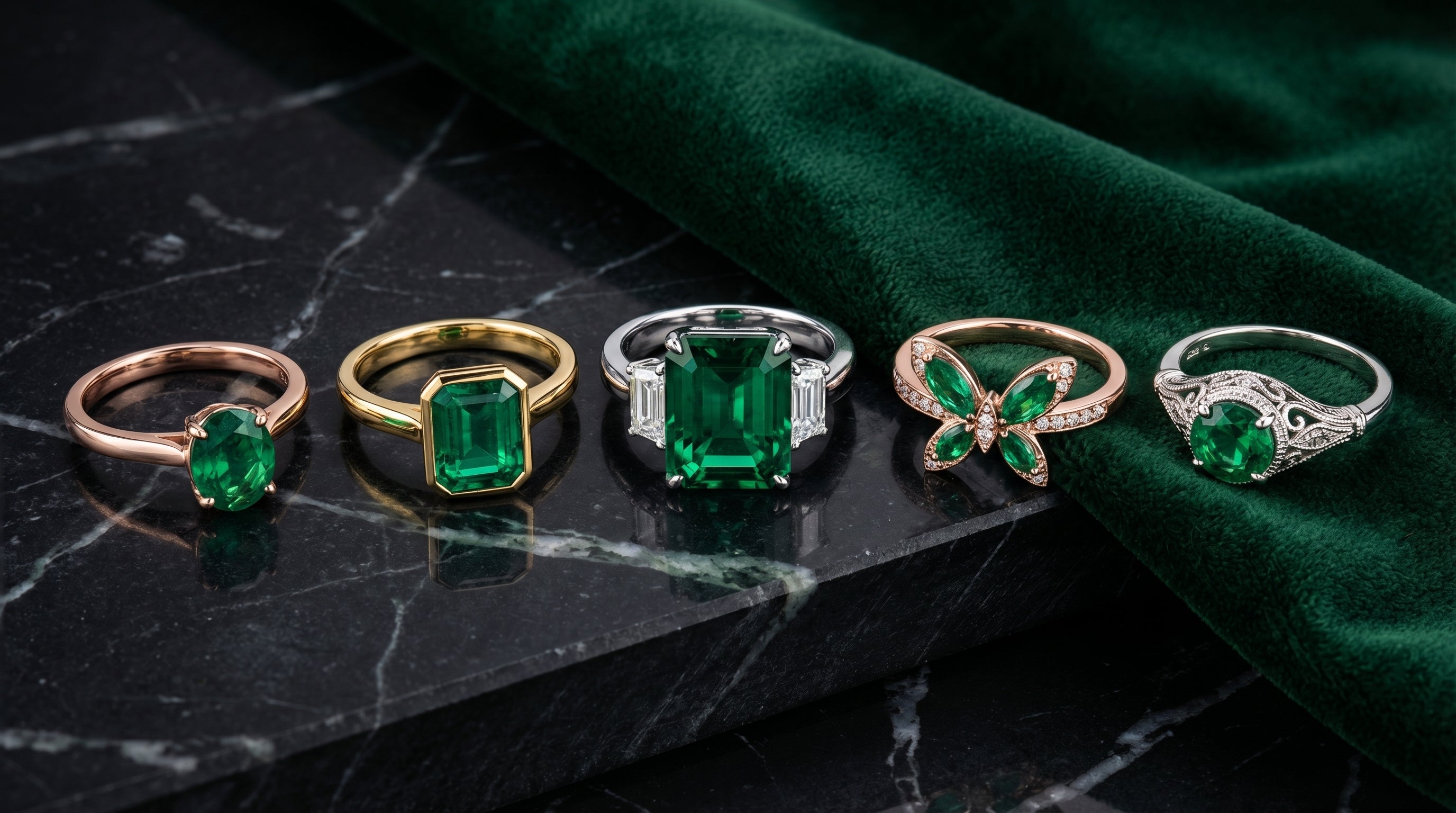
Colombian emerald engagement rings have a pull unlike anything else in the jewelry world. That legendary, saturated green—warm, deep, and almost luminous—explains why these stones have adorned royalty and romantics for centuries. But here's the thing: buying one in 2026 means navigating a genuinely complex landscape of durability concerns, clarity treatments, and origin premiums that most jewelers won't volunteer upfront. This guide cuts through all of it, so you can make a decision you'll feel confident about for decades.

What to Know Before Buying Colombian Emerald Engagement Rings
Before buying Colombian emerald engagement rings, you must understand their moderate durability, the near-universal prevalence of clarity enhancements, and the steep premium placed on origin. Many modern couples now choose durable, lab-created green moissanite to achieve the same lush aesthetic without the fragility or the five-figure price tag.
The Allure of the Colombian Green
Color is the undisputed king of the emerald world. While beautiful emeralds are mined in Zambia, Brazil, and other locations, Colombia remains the premier source in the global imagination. The mines nestled in the Eastern Cordillera of the Andes produce stones with a legendary warmth and intense saturation that gemologists describe as vivid bluish-green to pure green, with a medium to medium-dark tone.
Too light, and the stone looks washed out. Too dark, and it appears inky and lifeless. The perfect Colombian stone hits a visual sweet spot that seems to glow from within—a quality that carries enormous emotional and historical weight. You're not just buying a green stone; you're buying a piece of geological history. But that romance can blind buyers to practical realities. The "Colombian" label acts as a powerful marketing tool, sometimes used to justify exorbitant prices for stones with mediocre clarity or poor cuts. Learn to evaluate the stone in front of you, not just the prestige of its origin story.
The Reality of Daily Wear and Durability
Here's the hard truth many jewelers hesitate to share: natural emeralds are fragile. On the Mohs scale, they sit between 7.5 and 8. That sounds reasonable until you understand that hardness only measures scratch resistance. Toughness—the ability to resist chipping and breaking—is where emeralds genuinely struggle. Because they naturally form with numerous internal fractures and inclusions, their structural integrity is compromised. Gemologists describe their toughness as "fair to good," which is a polite way of saying they demand constant caution.
A simple knock against a granite countertop, a heavy door handle, or gym equipment can chip or shatter the stone. Ultrasonic cleaners? Off-limits. Harsh household chemicals? Absolutely not. For many brides in 2026, that level of daily vigilance is exhausting. This is precisely why we're seeing a surge in couples choosing lab-created alternatives with superior toughness—a 9.25 on the Mohs scale versus an emerald's 7.5 to 8—so they can enjoy the visual drama of a colored gem without the daily anxiety. If you want to understand exactly how different stones hold up to real life, read our comprehensive guide on Moissanite vs Diamond Hardness: What You Need to Know.
Key Factors in Choosing Your Emerald Ring
The key factors for choosing an emerald ring are color, clarity, cut, and carat weight. Unlike diamonds, color is paramount, and natural inclusions—known as jardin—are expected and accepted. Step cuts protect the stone while maximizing its vivid green hue and vintage appeal.
Color and Clarity: Embracing the Jardin
Approach an emerald with a diamond mindset and you'll be disappointed. With diamonds, we hunt for flawless clarity. With emeralds, we expect and embrace imperfection. Those internal characteristics—tiny fractures, liquid-filled cavities, mineral crystals—are so common they have a romantic French name: jardin, meaning garden. A natural emerald without any visible jardin is exceedingly rare and commands an astronomical price.
The trade applies far more lenient clarity expectations to colored stones. An emerald that would be graded heavily included by diamond standards can still be considered top-tier if its color is magnificent. The goal is a stone where inclusions don't severely disrupt transparency or threaten structural stability. If a fracture reaches the surface near an edge or corner, that's a serious vulnerability. You want a stone that looks vibrant and "awake," not murky or sleepy.
The Vintage Appeal: 1920s Art Deco and Emerald Cuts
If you're drawn to vintage emerald engagement rings, you're in excellent company. The geometric precision of vintage emerald cut rings perfectly captures the architectural elegance of the art deco era. Hunting for a real emerald ring vintage piece from that period is a genuine treasure hunt—and many brides specifically seek out vintage emerald engagement rings 1920s styles for their intricate milgrain, bold symmetry, and platinum filigree work.
The emerald cut itself was designed with this fragile green stone in mind. By truncating the corners into an octagonal shape, gem cutters removed the sharp, vulnerable points most likely to chip. The long, parallel step facets don't produce the fiery sparkle of a brilliant cut; instead, they create a mesmerizing hall-of-mirrors effect that emphasizes depth of color. Today's vintage emerald rings for women recreate this magic using modern engineering. A classic vintage emerald and diamond ring or a geometric vintage art deco emerald ring offers timeless sophistication that never goes out of style. For a deeper dive into historical styles, explore The Ultimate Guide to Vintage Engagement Rings: Timeless Charm Meets Modern Brilliance.
| Feature | Natural Colombian Emerald | Green Moissanite / Lab Alternatives |
|---|---|---|
| Durability (Mohs) | 7.5 - 8 (Prone to chipping) | 9.25 (Highly resistant to scratching/chipping) |
| Clarity | Usually included (Jardin) | Flawless to VVS clarity |
| Treatments | Almost always oiled or resin-filled | Untreated, structurally stable |
| Price per Carat | $500 - $15,000+ | Highly accessible and consistent |
| Daily Wear Suitability | Requires extreme caution | Excellent for everyday wear |
Price Ranges and Value in 2026
In 2026, commercial Colombian emeralds cost between $500 and $2,000 per carat, while fine, untreated stones exceed $15,000 per carat. Lab-created alternatives like moissanite offer exceptional durability and comparable visual impact for a fraction of that price.
The Origin Premium and International Trade
Pricing a natural emerald is notoriously difficult for the average consumer. The trade of colombian emeralds international relies heavily on the prestige of origin. Two stones that look nearly identical to the naked eye can carry wildly different price tags simply because one has paperwork proving it came from Colombia, while the other is from Zambia or Brazil.
For engagement ring sizes—typically 1 to 2 carats—commercial-grade Colombian stones range from $500 to $2,000 per carat. These will likely have visible inclusions and uneven color. Mid-range stones jump to $2,000 to $5,000 per carat. A fine Colombian emerald with vivid saturation, excellent transparency, and minimal treatment runs $10,000 to $15,000 per carat, or higher. Because the price curve is exponential, a 3-carat fine stone costs significantly more per carat than a 1-carat stone of equivalent quality. That math adds up fast.
Treatments and Enhancements
Assume that any natural emerald you look at has been treated. It's standard industry practice to fill surface-reaching fractures with cedarwood oil or modern polymer resins, dramatically improving apparent clarity by hiding the white, reflective cracks inside the gem. The level of treatment heavily impacts value—a stone with "minor" oiling is worth significantly more than one with "significant" resin filling.
And honestly? These treatments aren't permanent. Oils dry out. Resins discolor or leak when exposed to heat or harsh chemicals. If you accidentally clean a heavily treated emerald in an ultrasonic cleaner, the filler strips out, suddenly revealing a cloudy, fractured stone that looks nothing like what you purchased. This reality pushes many modern buyers toward lab-created stones or moissanite, which require zero clarity enhancements and remain structurally perfect for life.
How to Spot Quality and Authenticity
Spot quality in emerald rings by demanding independent lab reports from GIA or IGI that disclose both origin and treatments. Look for protective settings like bezels or halos, and expect natural internal inclusions rather than flawless, glass-like clarity in any genuine stone.
Certification is Non-Negotiable
Never buy a high-value natural emerald on a jeweler's word alone. You need independent verification. Reputable laboratories like the Gemological Institute of America (GIA) or the International Gemological Institute (IGI) issue Colored Stone Identification & Origin Reports that confirm whether a stone is natural or synthetic, identify geographic origin where determinable, and—critically—state the presence and extent of any clarity enhancements.
If a deal seems too good to be true, it is. A massive, vivid green "Colombian emerald" priced at $800 isn't a hidden gem; it's likely green glass, a synthetic simulant, or a heavily treated low-grade stone. Authentic fine-quality natural emeralds are inherently expensive. Under a jeweler's loupe, you want to see natural, organic-looking inclusions. If the stone looks unnaturally clean, shows gas bubbles, or has perfectly uniform color zoning, walk away.
Setting Styles for Protection
Because of their fragility, how an emerald is set matters as much as the stone itself. Bezel settings are the gold standard for fragile gems—a continuous rim of metal encircles the entire perimeter, acting like a protective bumper against daily impacts. Half-bezels offer a great compromise, protecting the ends while allowing more light to enter the sides.
If you prefer prongs, make them substantial. V-prongs that wrap around the corners of an emerald cut are far safer than standard round prongs. Halo settings also provide excellent protection; the surrounding ring of smaller stones acts as a physical buffer, absorbing the brunt of accidental knocks before impact reaches the center stone. To learn more about how different mountings protect your investment, read The Ultimate Guide to Ring Settings: Enhancing Brilliance, Style, & Security.
Our Top Recommendations for 2026
Our top recommendations for 2026 capture the architectural beauty of the emerald cut using highly durable, ethically created moissanite and lab-grown diamonds. These pieces deliver the vintage aesthetic you're after with the everyday resilience your lifestyle demands.
We've helped over 250,000 customers find their perfect piece, and we hear the same thing repeatedly: people want the geometric glamour of the 1920s without the fragility, the ethical concerns, or the staggering price tag. Every ring below is GRA-certified, backed by our lifetime warranty, and ships with secure checkout and 30-day returns. That's the Awareness Avenue promise. Browse our full engagement rings collection or explore our dedicated emerald cut collection to see every option.

For those who adore the classic step-cut aesthetic, The Adelina Rae is an absolute standout. Featuring a 2-carat emerald cut moissanite with a refractive index of 2.65–2.69—higher than diamond's 2.42—this ring throws light in a way that stops people mid-sentence. The elongated silhouette is pure 1920s vintage, and at 9.25 on the Mohs scale, you can wear it every single day without the chipping anxiety that comes with natural emeralds.

If you want the ultimate in structural perfection and ethical sourcing, The Mariposa is breathtaking. This ring features an emerald cut lab-grown diamond—chemically and optically identical to a mined diamond, rated a perfect 10 on the Mohs scale. The step facets of the emerald cut demand absolute clarity, and this lab diamond delivers a flawless, icy hall-of-mirrors effect that natural emeralds can't match without heavy treatments. It's the kind of ring that earns compliments in direct sunlight and candlelight equally.

The Astrid Emerald Cut Bezel Ring takes the protective setting advice above and turns it into art. The sleek, continuous metal rim surrounding the emerald cut moissanite protects every edge while creating a bold, architectural look that feels simultaneously modern and deeply rooted in art deco tradition. It's the perfect low-profile ring for an active lifestyle—and with moissanite's dispersion of 0.104 (2.4 times that of diamond), the rainbow fire it throws in direct sunlight is genuinely jaw-dropping.

For a softer, more romantic take on the geometric cut, The Solace - Rose is magnificent. The warm blush of the rose gold setting contrasts beautifully with the crisp, clean lines of the 1-carat emerald cut lab-grown diamond. It proves you don't need a green stone to capture the vintage romance of the 1920s—the right cut and the right metal create a piece that feels entirely timeless. The satisfying weight on the finger and the way the step facets catch light at every angle make this one of our most-loved pieces.
Finally, if you want the bold statement of color but demand the durability of moissanite, The Camilla commands attention. A massive 3-carat emerald cut pink moissanite delivers the dramatic visual impact of a colored gemstone with none of the fragility. It's a fearless, joyful ring—and it's available in multiple colorways including our full colored gems collection for those who want to explore every option.
Frequently Asked Questions
Our frequently asked questions cover the realities of daily wear, the durability of vintage pieces, the benefits of moissanite alternatives, and the safest cleaning methods for your precious gemstone rings.
Can I wear a natural Colombian emerald engagement ring every day?
You can, but it requires significant lifestyle adjustments. Natural emeralds are prone to chipping and cracking due to their internal inclusions and fair-to-good toughness rating. You'll need to remove the ring before exercising, cleaning, gardening, or any heavy lifting. If you want a ring you never have to take off, a lab-created diamond or moissanite—rated 9.25 to 10 on the Mohs scale—is a far safer choice for daily wear.
Are vintage emerald engagement rings from the 1920s durable enough for modern wear?
True antique rings from the 1920s are often quite fragile. The platinum settings may have worn thin over a century, and the original emeralds have likely sustained micro-abrasions or chips. They're beautiful collector's items, but for daily wear, a modern ring designed with vintage aesthetics—like a new emerald cut moissanite in a milgrain setting—is vastly superior in terms of security and peace of mind.
Why choose green moissanite over a natural Colombian emerald?
Green moissanite offers the lush, vibrant color of an emerald with a hardness of 9.25 on the Mohs scale, making it resistant to both scratching and chipping. It requires no oil or resin treatments to look beautiful, carries GRA certification, and costs a fraction of a fine natural emerald—allowing you to invest in a larger stone or a more elaborate setting without compromise.
How do I safely clean my emerald or moissanite ring?
For natural emeralds, never use ultrasonic cleaners, steam, or harsh chemicals—these strip the oils and resins used to treat the stone. Use only warm water, mild dish soap, and a very soft brush. Moissanite and lab diamonds, however, are structurally perfect and can be cleaned safely with ultrasonic devices or standard jewelry cleaning solutions to maintain their brilliant fire and scintillation.
Final Advice for Your Forever Ring
Your engagement ring should be a source of joy, not anxiety. By understanding the care requirements of natural emeralds—or choosing a durable moissanite alternative—you can confidently select a ring that perfectly symbolizes your unique love story.
Falling in love with the rich history and vibrant color of Colombian emerald engagement rings is easy. Living with one day-to-day takes a bit more pragmatism. If your heart is set on a natural green stone, prioritize protective settings like bezels, demand rigorous lab certification from GIA or IGI, and commit to the careful maintenance it requires. But if you love the architectural beauty of the vintage emerald cut and need a ring that keeps up with a modern, active lifestyle, lab-created alternatives are a revelation. Moissanite and lab-grown diamonds offer the exact geometric glamour of the 1920s without the fragility, the ethical concerns, or the staggering price tag. The best ring is the one you wear with absolute confidence, every single day. Explore our engagement rings collection or discover the perfect step-cut geometry in our emerald cut collection to find the piece that speaks to your soul.

Laat een reactie achter
Deze site wordt beschermd door hCaptcha en het privacybeleid en de servicevoorwaarden van hCaptcha zijn van toepassing.