
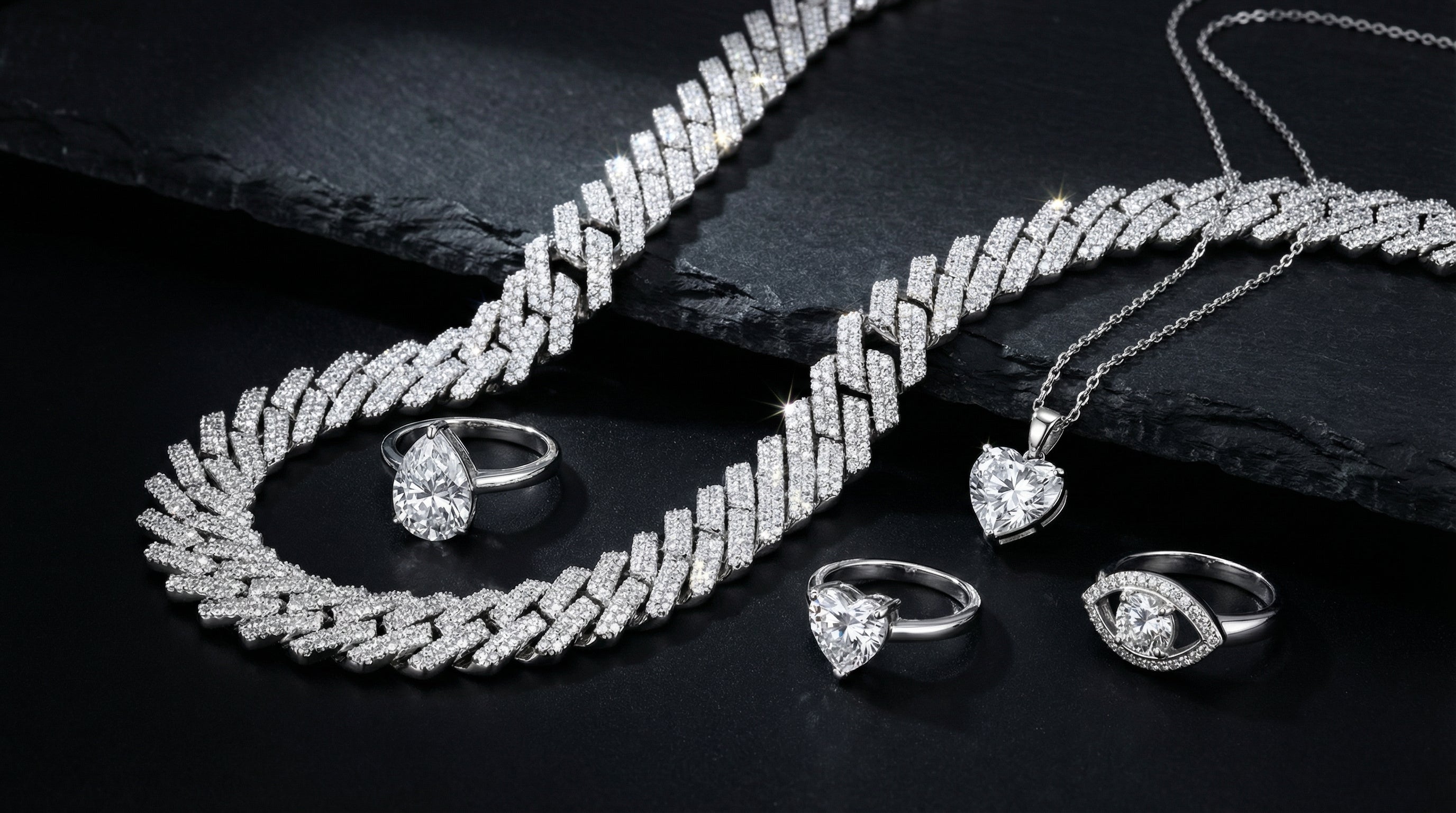
Open two browser tabs. In one, a men's diamond tennis chain advertised with a big total carat weight and a price that feels impossibly low. In the other, a chain that looks almost identical in photos, costs several times more, and comes with grading paperwork. Both listings say "real diamond." Both may be technically accurate. The entire difference is hidden in how that carat weight is distributed, how the stones were graded, and how the chain was engineered to survive being worn under a shirt collar every day.
That gap is where most men's diamond necklace regret happens. Not in choosing the wrong style, but in paying for a number on a spec sheet that has almost no relationship to how the piece looks in daylight or how long it lasts. This article works through the objections that actually stall the purchase — authenticity, price, durability, appearance, and the moissanite question — and gives you the exact questions to ask before you check out.
Objection 1: "How do I even know it's a real diamond?"
"Real" is a weaker word than most buyers assume. It confirms the material, not the quality, and not the value.
Real, graded, and certified are three different claims
A stone can be a genuine mined diamond and still be low color, heavily included, poorly cut, or treated to improve its appearance. Independent laboratory reports exist precisely because "real" is not a quality statement. The Gemological Institute of America (GIA) and the American Gem Society (AGS) are the reports buyers most often look for on higher-value stones, with the International Gemological Institute (IGI) also widely used. A report itemizes carat weight, color, clarity, cut, polish and symmetry, fluorescence, and the plotted inclusions that make the stone identifiable.
The consensus advice from reputable online diamond sellers is blunt: above roughly the low four figures, do not buy an ungraded diamond. Without an independent report you have no objective proof of what you own and no leverage if the stone turns out to be treated — irradiated, coated, or fracture-filled — or simply overstated on color and clarity.
Why most men's tennis chains don't come with a report per stone
Here is the detail almost nobody explains at the point of sale. A diamond tennis chain or iced-out Cuban link is built from melee — dozens or hundreds of tiny stones. Individual laboratory reports are issued for larger single stones; grading every melee stone in a chain would cost more than the chain. So sellers rely on in-house grading, batch descriptions, or vague phrases like "VVS-clarity simulated," "diamond-cut," or "diamond-quality."
Read those phrases literally. "Diamond-cut" describes a faceting style, not a material. "Simulant" means it is not diamond at all. If a listing advertises a very large total carat weight at a very low price with no per-stone grading and no clear material statement, the honest interpretation is that you are buying either extremely small, low-grade melee or a diamond substitute. Neither is fraud if it is disclosed — the problem is when the disclosure is buried.
The verification checklist
- Ask what the report covers. One report for a center stone in a pendant is normal. A chain of melee will not have one — so ask what the in-house grading is based on and get it in writing on the invoice.
- Match the report to the piece. For a graded solitaire, the report number is typically laser-inscribed on the girdle and should match the paperwork.
- Get the material named explicitly. Natural diamond, lab-grown diamond, moissanite, or cubic zirconia. Any listing that avoids naming the material is answering the question by omission.
- Demand real photography or video of the actual piece rather than stock renders, especially for anything with visible melee.
- Check the metal claim separately. Hallmarks such as 925, 585 (14K), or 750 (18K) tell you what the chain is; "gold" alone can mean plated or filled.
Objection 2: "Am I overpaying?"
This is the most common frustration in jewelry buyer communities, and it has two separate causes that get blamed on each other.
Cause one: markup you can't see
Jewelry retail has long operated on substantial markups over wholesale stone cost, which is why the same specification can carry wildly different prices between a mall chain, a legacy luxury house, and a transparent online seller. You cannot audit a markup, but you can neutralize it: for any graded diamond, compare the exact same specification — carat, color, clarity, cut, plus polish and symmetry — across at least three sellers. Price per carat for identical specs is the only apples-to-apples comparison that exists. If a seller won't give you the specs in a format you can compare, that is the answer.
Cause two: paying for the wrong attributes
Buyers reliably overweight carat weight, because size is the one variable you can see in a photo. GIA's own educational material makes the opposite case: cut quality governs light return, so a well-cut stone of modest weight can visibly outperform a larger stone with a mediocre cut and lower color grade. In a necklace, this matters more than in a ring, because the piece is viewed at conversational distance under mixed lighting, where brilliance reads long before millimeters do.
Practical hierarchy for a men's piece: cut first, then color, then clarity, then carat. For melee-set chains, invert the emphasis entirely — what you are really buying is setting precision, uniform stone matching, and plating or metal quality, because no individual stone in the chain is large enough for clarity grade to matter to the naked eye.
Where the rest of the money goes
Ask any seller to break the piece into four buckets: stones, metal, labor, and brand. Metal choice alone moves the number significantly. White gold needs periodic rhodium replating to stay bright. Yellow gold shows surface wear more openly but never needs re-plating. Platinum is denser and highly durable, but carries a clear premium over gold for the same design. Sterling silver keeps the entry cost low and suits statement widths that would be prohibitively heavy in solid gold. If you want a deeper look at metal and construction trade-offs, our men's chain link necklace guide covers link styles and gauge in detail.
Objection 3: "Is it actually safe to wear every day?"
This is the objection men rarely say out loud, and it is the one that most often ends with an expensive necklace living in a drawer.
Diamond sits at 10 on the Mohs hardness scale — the hardest natural material, and the reason "scratch resistance" is the industry's favorite talking point. But scratching is almost never how a men's necklace fails. Necklaces fail at the joints: a bent prong, a spread bezel, a fatigued jump ring, a lightweight clasp, or a solder point that gives out where the pendant bail meets the chain.
What to inspect before buying
- Setting type. A bezel — metal wrapped around the stone's girdle — protects better under a shirt, a seatbelt, and a gym bag strap than an exposed prong or tension setting.
- Clasp quality. A lobster clasp with a heavy gauge spring, or a box clasp with a safety catch, is worth more to you than an extra tenth of a carat.
- Bail and chain matched to weight. A common mistake is buying a pendant and a chain separately: a heavy pendant on a thin chain concentrates stress at one point. Integrated design — pendant, bail, and chain engineered together — is what prevents loss.
- Link construction. Solid links outlast hollow links under real wear. Hollow chains look substantial for less weight and dent permanently.
Living with it
Sweat, sunscreen, cologne, and chlorine dull any set piece by coating the stones and the metal underneath them. Warm water, a drop of mild dish soap, and a soft brush restores most of the sparkle; the film sitting under melee stones is the usual reason a chain "stopped shining." Take necklaces off for contact sports and heavy lifting, and have prongs and clasps checked periodically — the same maintenance logic that applies to any daily-wear fine jewelry.
Objection 4: "Will it actually look right on a man?"
Proportion decides this, not the stone. A pendant that reads well on a woman's 16-inch chain often looks undersized at 22 inches on a broader frame — same piece, different scale relationship.
Length
Roughly: 18 inches sits at the base of the neck and works with an open collar; 20 to 22 inches lands at or just above the sternum, the most versatile range for a visible pendant; 24 inches and longer sits mid-chest and reads deliberately as a statement, especially over a tee.
Width and stone size
For iced tennis or Cuban styles, narrow widths layer cleanly and stay office-appropriate, while wider widths become the focal point and stop playing well with other chains. For solitaire pendants, a bezel-set stone in the range that reads clearly at arm's length — rather than the largest stone your budget allows — usually photographs and wears better.
One chain or a stack
An iced chain plus a plain solid link chain at differing lengths is the most forgiving combination: the sparkle has somewhere to sit against. Two iced chains at similar lengths compete. Our guide to men's gold necklace pendants works through pendant-and-chain pairing if you're building a stack rather than buying a single piece.
Objection 5: "Isn't moissanite just a fake diamond?"
The "fake" label is a holdover from earlier generations of the material, and it collapses the moment you separate two different questions: is it a diamond, and is it good jewelry?
Moissanite is not a diamond, and no honest seller should imply otherwise. It is its own gem material, silicon carbide, and it registers 9.25 on the Mohs scale against diamond's 10. Gemological literature treats 9.25 as suitable for any jewelry application, including daily-wear necklaces — and, as covered above, hardness is not the failure mode for a necklace anyway. The clasp, the prongs, and the bail decide the lifespan of your chain, whichever stone sits in it.
Moissanite also grades and certifies. GIA has offered grading reports for moissanite, although the wider ecosystem remains less standardized than diamond grading, which means the burden falls on the seller to state specifications plainly instead of hiding behind borrowed diamond vocabulary.
The comparison that actually matters for a necklace
| Factor | Mined diamond | Moissanite |
|---|---|---|
| Mohs hardness | 10 | 9.25 |
| Practical durability in a necklace | Excellent; failures occur at settings and clasps | Excellent; failures occur at settings and clasps |
| Independent grading | Mature system (GIA, AGS, IGI) for larger single stones | Available, less standardized; per-stone reports uncommon in melee |
| How it's usually sold in chains | Ungraded melee described in-house | Ungraded melee described in-house |
| Daily-wear mindset | Higher-value pieces often get stored rather than worn | Lower financial exposure supports actual daily wear |
| Where your budget goes | A large share into the stone material | More available for setting quality, metal, and design |
| Resale | Some secondary market, highly variable; no consolidated pricing data for men's necklaces | Treat as a wearable purchase, not an asset |
Notice what that table does not claim: that moissanite is a diamond, or that a diamond is a bad purchase. If the mined origin of the stone is part of what you want to own, buy a graded diamond and buy it from someone who shows you the report. If what you want is a necklace that looks sharp at conversational distance, survives a full week of wear, and doesn't make you nervous at the airport, the stone material is doing less work in that decision than the setting and the chain.
The honest reframe on "status"
Buyers comparing the two usually frame it as value versus status. It's worth being precise: nobody at a dinner table is loupe-testing your chain, and a poorly cut, low-color diamond chain will look worse than a well-made moissanite one. The status signal in men's jewelry is craftsmanship — even melee spacing, tight prongs, clean plating or solid metal, a clasp that closes with authority. That is visible. Certificates are not.
How to shop it: the short version
- Name the material and get it in writing on the invoice: natural diamond, lab diamond, or moissanite.
- For a single-stone pendant, insist on an independent report and prioritize cut, then color, then clarity, then carat.
- For an iced chain, judge construction instead of stone paperwork: stone matching, setting security, link solidity, clasp strength.
- Verify the metal by hallmark, and decide consciously between solid gold, platinum, and sterling silver based on width, weight, and how often you'll wear it.
- Buy the length before the stone size. Get 20 to 22 inches right and almost any pendant scale works.
- Compare identical specs across three sellers before accepting any price as fair.
If you land on the moissanite side of the decision, our men's moissanite pendant buying guide goes deeper on chain pairing, and the Men's Iced Moissanite Cuban Link Chain in S925 sterling silver is the piece most men start with because the Cuban profile carries stone-set width without looking delicate. You can browse the full necklaces collection to compare pendant styles and lengths side by side.
Frequently asked questions
Do men's diamond necklaces hold their value?
Diamonds have a reputation for value retention, but there is no consolidated secondary-market pricing data for men's diamond necklaces, and realized resale prices vary widely by design, stone grade, and buyer. Treat any necklace as something you bought to wear. If genuine asset behavior is the goal, that is a different purchase with different paperwork.
Is 14K or 18K better for a men's chain?
Both are used widely. Some jewelers favor 18K for men's chains for the richer color and heft; 14K contains more alloy, which affects hardness and cost. In practice the variables that decide whether a chain survives are gauge, whether links are solid or hollow, and clasp quality — not the karat number alone. Compare weight in grams at the same length and width before you compare karats.
Should I buy the pendant and chain separately?
Only if you check the pairing carefully. Mismatched pendant weight and chain gauge is one of the most common reasons a piece is lost, because all the stress lands on the bail and a single link. Buying them designed together, or matching gauge to pendant weight deliberately, is the safer route.
Can a jeweler tell moissanite from diamond?
Yes — with the right instrument, a trained gemologist can distinguish the two, which is exactly why sellers should label material honestly rather than trading on ambiguity. What a jeweler can identify with testing equipment and what a stranger notices across a room are very different standards.
What about matching earrings or a ring?
Match stone material and metal tone first, then finish. A polished white chain next to a matte white ring reads as an accident rather than a set. If you're pairing a chain with studs, our breakdown of VVS diamond earrings versus moissanite for men applies the same grading and setting logic at a smaller scale.
How often should a set necklace be checked?
Have prongs, bezels, and the clasp inspected periodically, and clean the piece yourself between inspections with warm water and mild soap. Loose settings are usually catchable before a stone is lost; a fatigued clasp almost always announces itself as an increasingly loose closing action.
The bottom line
The phrase "real diamond necklace" sells confidence, but confidence should come from documents and construction, not adjectives. Ask what material it is. Ask for the report if there is one, and ask what the grading is based on if there isn't. Look at the clasp before you look at the carat weight. Then decide honestly whether you are buying the mined origin of the stone, or the way the necklace looks and feels every day — because those two goals point to genuinely different purchases, and only one of them will end up in the drawer.

Laat een reactie achter
Deze site wordt beschermd door hCaptcha en het privacybeleid en de servicevoorwaarden van hCaptcha zijn van toepassing.