


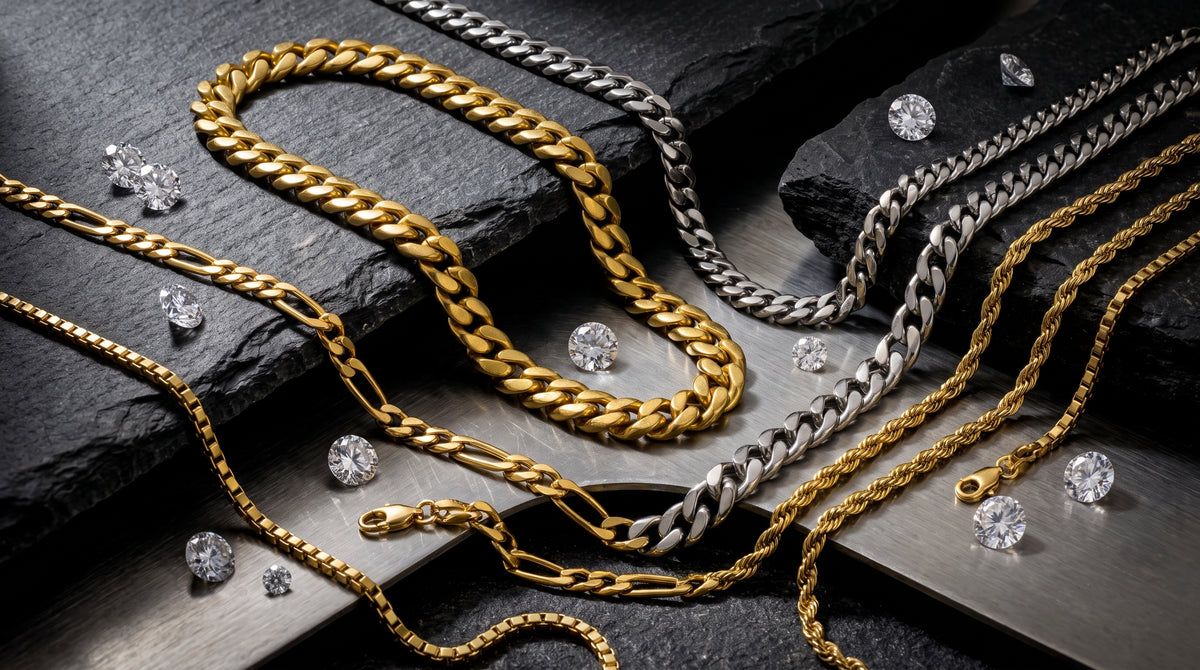
A mass-market titanium curb chain sold at Target gives you a useful anchor number: 7.5 mm wide, 18 inches long, and an average weight of 21.13 grams. That is a genuinely broad chain that weighs less than many far thinner steel pieces. Published density comparisons put titanium roughly 40–50% lighter than stainless steel by volume, so the same curb link profile cut from steel would plausibly land closer to the high-30-gram range. That single contrast — wide but weightless — is the entire reason men search for a titanium chain necklace rather than simply a chain.
The harder question is whether that weight saving, plus titanium's nickel-free chemistry, is worth what it costs you in design choice and budget. This comparison works through the evidence metal by metal, then applies it specifically to chains, which behave differently from rings and cuffs because they bend, rub against collars, and carry a clasp. One disclosure up front so nothing here reads as a bait-and-switch: Awareness Avenue does not currently sell titanium chains. Our necklaces are stainless steel and gold-tone stainless steel. You will find them discussed honestly on the steel side of this comparison, and nowhere else.
What people actually want when they search for a titanium chain necklace
The phrase "men's chain necklace titanium" combines a gendered audience, a specific product form, and a material constraint, and the results that serve it are overwhelmingly shopping pages rather than essays. Titanium is treated as a standalone material category for men by houses like Tiffany & Co., which lists men's titanium necklaces and pendants including a Pharrell Williams "Tiffany Titan" necklace in titanium and gold with diamonds. David Yurman sells box chain necklaces in grey titanium paired with sterling silver at widths such as 2.7 mm and 3.6 mm, and lists titanium alongside platinum, sterling silver and gold within its curb chain collection.
Below that tier sit functional specialists. Maven Metals specifies commercially pure Grade 2 titanium for its men's curb chains at 3.5 mm and 4.25 mm with a titanium lobster clasp, and markets them as waterproof, sweatproof, hypoallergenic and light enough for everyday wear. Titanium Kay lists titanium chains next to tungsten and stainless steel options, which tells you something important: shoppers routinely cross-compare metals inside one category rather than committing to titanium first. Marketplaces add volume and noise — Amazon returns over a thousand results for men's titanium necklaces and more than two thousand for titanium necklaces generally.
So there are really three buyers here. One already wants titanium and needs a style and width. One has sensitive skin and heard titanium is the safe answer. One simply wants a chain that survives daily wear and is testing whether titanium justifies the premium over steel. The third group is the largest, and the evidence below is aimed at them.
Titanium vs stainless steel: the spec sheet that matters for a chain
| Property | Titanium (Grade 2 / Grade 5 in jewelry) | Stainless steel (typically 316L in jewelry) |
|---|---|---|
| Weight by volume | Roughly 40–50% lighter than steel; wide chains still feel light | Medium-heavy; the same profile reads as "solid" on the neck |
| Hardness | Grade 5 around 36 HRC; lower hardness, higher toughness | 316L around 85 HRC; resists fine scratching early on |
| Wear behavior | Dents locally under impact; finish stays more consistent under abrasion | Scratches finely; high-polish surfaces dull faster with daily friction |
| Long-term oxidation | Negligible mass change (within ±0.07%) over a 36-month wear test | Mass gain of 1.8–3.2% over 36 months from surface oxidation and embedded debris |
| Saltwater exposure | No comparable pitting observed in immersion testing | Pitting observed at drill holes in most immersed samples |
| Nickel and skin | Nickel-free at jewelry purities; highly hypoallergenic | Generally well tolerated in 316L, but can contain nickel |
| Color | Natural grey; can be polished or anodized without losing hypoallergenic behavior | Bright silver-gray from chromium; also coated in gold, rose or black tones |
Weight: the difference you notice first and forget last
Weight is the most immediately perceptible difference, and it is not subtle. Consumer comparison guides describe titanium as roughly 40–50% lighter than steel for the same size item, and independent testing puts titanium's density about 45% below stainless steel. In chain terms, that means you can wear a visually bold width without the pull at the back of the neck that makes men take a heavy chain off by mid-afternoon. It also means titanium reads as less "present" — some buyers want jewelry they can feel, and a light chain can feel insubstantial to them. Neither reaction is wrong; it is a preference you should test before spending.
Hardness versus toughness: scratches versus dents
This is the most misunderstood part of the comparison, because "harder" and "more durable" are not the same claim. Independent wear testing places 316L stainless steel around 85 on the Rockwell C scale against roughly 36 HRC for Grade 5 titanium. Steel therefore shrugs off fine scratching better at the beginning. But the same testing found steel's high-polish finish dulls faster under continuous abrasive contact — desk edges, belt loops, gym chalk — while titanium held a more consistent finish under identical abrasion and instead showed localized denting under impact. Put plainly: steel accumulates a hazy field of micro-scratches, titanium accumulates a few small dings. Which aging pattern you prefer is aesthetic, not technical.
Corrosion, sweat and saltwater
Over a 36-month wear test, stainless steel pieces gained 1.8–3.2% in mass from surface oxidation and embedded debris, while titanium pieces stayed within ±0.07% — effectively unchanged. In saltwater immersion designed to mimic regular beach exposure, most stainless samples pitted at drill holes; titanium did not show comparable damage. Neither metal rusts in the way carbon steel does, and the steel damage documented was cosmetic rather than structural. But if your chain lives in the ocean or in heavy sweat, titanium is the lower-maintenance answer, and specialist sellers price it accordingly.
Nickel, skin and who actually needs titanium
Brilliant Earth's guide to hypoallergenic jewelry metals names titanium as completely nickel-free at jewelry purities and highly resistant to corrosion, which is why it is recommended for sensitive skin and long-contact pieces. Consumer guides describe 316L stainless steel as generally safe and widely tolerated, while noting it can still contain nickel and may provoke reactions in highly sensitive wearers. If you have a diagnosed nickel allergy, that distinction is decisive and titanium is the rational buy. If you have worn steel watches and chains for years without irritation, the case for paying a titanium premium on allergy grounds alone is weak.
How the material difference shows up in a chain, not a ring
Almost every published titanium-versus-steel comparison is written around rings, earrings and cuffs. Chains behave differently, and three chain-specific consequences follow from the data above.
Links rub against each other, constantly
A chain is dozens of articulating contact points. That is abrasive wear in its purest form, which is exactly the condition where high-polish steel was observed to lose luster faster. Dense patterns with large flat faces — Cuban and curb links especially — show that dulling most obviously, because a broad polished plane is where haze is visible. Rope, wheat and box chains scatter light across many small facets, so surface haze hides better regardless of metal. If you like a mirror finish on steel, a tighter-textured pattern buys you more time between polishes.
The clasp is the weak point in both metals
Neither metal fails at the link under normal wear; clasps and jump rings fail. Titanium sellers who take the material seriously specify a titanium clasp rather than mixing a steel spring ring into a titanium chain, which matters for both allergy consistency and corrosion behavior. When you compare two listings, compare clasp material and type — lobster clasps, as used on David Yurman's grey titanium box chains, are the standard for men's chains at any price. A hidden metal swap at the clasp quietly undoes a hypoallergenic claim.
Width reads differently once weight is removed
Because titanium is so much lighter, a wider titanium chain drapes higher on the chest and swings less than a steel chain of the same width. That is why a 7.5 mm titanium curb can be worn all day, and also why titanium chains sometimes look bigger than they feel. If you are choosing width remotely, use measurements rather than impressions — our men's chain size chart maps millimeter widths and lengths to how a chain actually sits.
Grades and labels: Grade 2, Grade 5, 316L and "titanium steel"
Titanium is not one material. Grade 5 (Ti-6Al-4V) is the alloyed, high-strength version measured at roughly 36 HRC in wear testing; commercially pure Grade 2 is more ductile and contains no aluminum or vanadium, which is why independent testing recommends Grade 2 for anything in skin contact for more than about eight hours a day, and why Maven Metals specifies solid Grade 2 for its men's curb chains. For a necklace worn daily, Grade 2 is the relevant spec to look for.
On the steel side, 316L is the grade most jewelry testing and consumer guidance refers to. It is an iron-chromium alloy whose chromium content forms the protective oxide layer responsible for its tarnish resistance and bright silver tone. Coated variants deserve a caution: independent testing advises care with black and rose-gold PVD finishes on steel and favors mill or satin finishes for longevity, since any coating is a wear surface that can eventually reveal the metal underneath.
Then there is the label to watch for. Social commerce listings frequently use "titanium steel" — TikTok Shop results for titanium men's necklaces surface items titled as "Men's Silver Titanium Steel" pieces. That phrase is marketing shorthand, not a defined alloy, and it borrows titanium's reputation for durability and anti-tarnish behavior without guaranteeing titanium's nickel-free composition. If hypoallergenic performance is your reason for buying, a listing that will not state a titanium grade or a steel grade has not answered your question.
Choose titanium if… choose stainless steel if…
Titanium is the better buy when
- You have a known nickel allergy or react to costume and mixed-metal jewelry.
- You want a wide chain without the weight — the 21.13-gram, 7.5 mm curb example is the clearest illustration.
- Your chain never comes off: swimming, sweating, saltwater, showering. The oxidation and pitting data favor titanium decisively here.
- You prefer a cool grey tone over bright silver, or want an anodized color that does not compromise the metal's skin behavior.
- You are content with a narrower design field — titanium chain offerings skew toward curb and box patterns.
Stainless steel is the better buy when
- You want the widest possible choice of patterns, widths and finishes, including gold-tone looks.
- You like a chain with heft, where weight signals substance.
- You rotate several chains rather than wearing one continuously, which limits abrasive dulling.
- You are building a first collection and want to test lengths and link styles before committing to a single expensive piece.
- Budget matters. At the material level, comparison guides consistently place stainless steel below titanium on cost, driven by material and machining differences. We are deliberately not quoting figures, because published ranges vary by brand and change without a reliable date.
Independent testing summarizes it neatly: titanium is the long-game metal, stainless steel is the workhorse. Both descriptions are compliments.
Where Awareness Avenue fits: stainless steel, stated plainly
We sit on the steel side of this comparison. Our chains are stainless steel and gold-tone stainless steel, and we do not currently offer a titanium chain — if titanium is a hard requirement for you, the specialists named above are where to look. What we do offer is the pattern range that titanium chains generally do not, which is the main practical trade-off buyers make when they choose steel.
If you want presence and a broad polished face, the Origin Cuban Set and the Originator Set are the statement end of the range. For everyday wear under a collar, narrower profiles suit better — the Everyday Armor Cuban Chain keeps the Cuban look at a wearable width, while the Gilded Wheat Chain and Legacy Rope Chain use the multi-facet textures that disguise everyday surface haze best. The full necklace range covers box, Figaro and rope patterns in both tones.
To keep this honest: we are not claiming a specific steel grade, nickel content, hypoallergenic status, waterproofing or corrosion performance for our chains here, because those are brand-level technical claims that belong on a product page with documentation behind them, not in a comparison article. What is fair to say is that stainless steel as a material is rust-resistant, robust in everyday wear, and the dominant choice in men's fashion chains — which is exactly why it dominates the category.
Sizing, styling and care for either metal
Width and length
The titanium chains on the market cluster instructively: 2.7 mm and 3.6 mm in luxury box chains, 3.5 mm and 4.25 mm in specialist curb chains, 7.5 mm at the mass-market end. That spread maps almost exactly onto steel chain conventions, so the metal does not change your sizing logic. Between 2 and 4 mm reads as everyday jewelry that layers and disappears under a shirt; above roughly 6 mm you are making a deliberate statement. Length does more work than width for most men — an 18-inch chain sits high on the chest, and the trade-offs of that length are covered in our 18-inch chain guide.
Care routines differ, and that is the point
Titanium's case for lower maintenance is the strongest single argument in its favor: negligible mass change over three years of wear testing and no comparable saltwater pitting means a rinse and a dry cloth is usually the whole routine. Steel asks slightly more of you. Because its polish dulls under abrasion faster, an occasional wipe with a jewelry cloth restores brightness, and it is worth rinsing after heavy sweat or pool sessions rather than letting residue sit in the links. Store chains flat or hung rather than coiled in a pocket, where link-on-link abrasion is worst. If you are weighing finishes and link patterns within steel specifically, our guide to men's chain link styles and our breakdown of silver-tone chain styles go deeper on which patterns age most gracefully.
Frequently asked questions
Is titanium stronger than stainless steel for a chain?
It depends which property you mean. Stainless steel is harder — roughly 85 HRC for 316L against about 36 HRC for Grade 5 titanium — so it resists fine scratches better at first. Titanium has a very high strength-to-weight ratio and is tougher in the sense that it deforms rather than abrading. Neither metal is structurally fragile in a well-made chain; the practical difference is how the surface ages.
Will a titanium chain turn my skin green?
Titanium at jewelry purities is nickel-free and highly corrosion-resistant, which is why hypoallergenic metal guides recommend it for sensitive skin. The discoloration people associate with cheap jewelry comes from reactive base metals and copper alloys, not from titanium.
Is "titanium steel" the same as titanium?
No. It is a marketing term used on some marketplace listings and carries no defined alloy specification. If the seller cannot name a titanium grade (Grade 2 or Grade 5) or a steel grade (such as 316L), treat the material claim as unverified.
Does titanium come in gold tone?
Titanium's natural color is grey, and it can be polished or anodized to alter its appearance without compromising its hypoallergenic behavior. If a warm gold look is what you want in a chain, stainless steel offers a far wider selection — see our notes on tones and pendant pairing in the men's necklace styles guide.
Which should I buy first if I have never worn a chain?
Start with a 2–4 mm chain in whichever metal fits your budget and skin, and wear it for a month before buying wider. The most common regret is not the metal — it is a chain that is heavier, shorter or bolder than the wearer actually wanted.

Leave a comment
This site is protected by hCaptcha and the hCaptcha Privacy Policy and Terms of Service apply.