
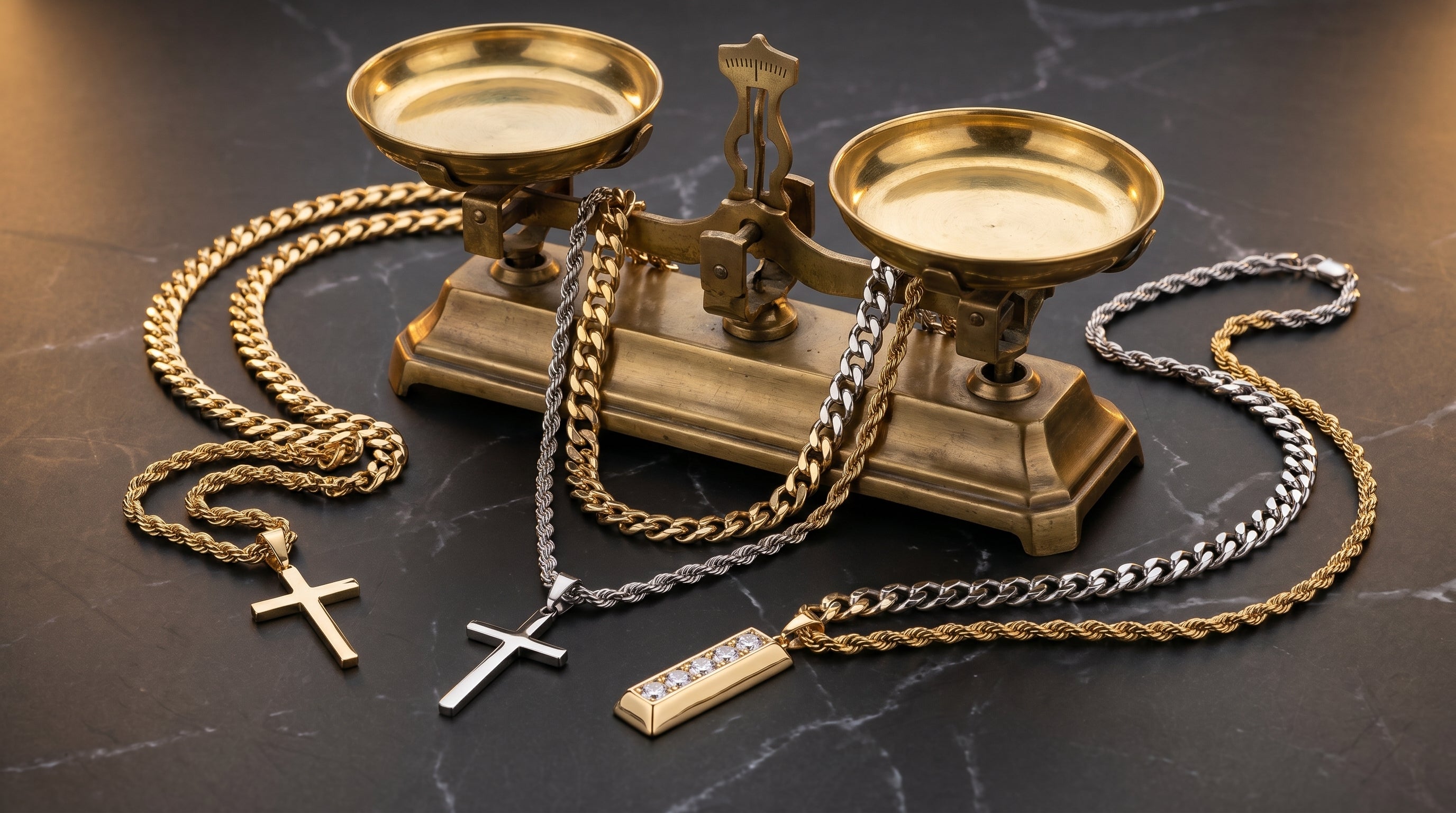
If you're standing at a jewelry counter trying to figure out whether the 14k gold chain price per gram actually justifies what's on the price tag, you're asking exactly the right question. Most buyers never do. The difference between the raw melt value of 14k gold and what retailers charge can be staggering—and understanding that gap is what separates a smart purchase from an expensive mistake. In 2026, with gold prices at sustained highs, this knowledge matters more than ever.

Buying a gold chain is an emotional experience. You're not just purchasing metal—you're acquiring a symbol of personal style, a marker of a milestone, or a future family heirloom. Yet the financial side of the transaction can feel completely opaque. Why does one chain cost double the price of another that looks identical? How much of that price is actual gold, and how much is the brand name stamped on the box? We're going to break down exactly how gold pricing works, how to calculate true value, and why modern alternatives are changing the way people build their jewelry collections.
What to Know Before Buying a 14k Gold Chain
Before buying a 14k gold chain, understand that retail price never equals the raw melt value of the gold. You're paying for the 58.3% pure gold content, plus alloy metals, jeweler's labor, design complexity, and the brand's retail markup—often totaling two to three times the metal's intrinsic worth.
To grasp the value of a 14k gold chain, you first need to understand what 14-karat gold actually is. Pure gold—24-karat—is soft. Wear a 24k chain daily and the links will stretch, warp, and eventually snap under the slightest tension. To make gold wearable, jewelers blend it with alloy metals like copper, silver, zinc, and sometimes nickel. This gives the metal the tensile strength required to survive real life.
A 14k gold chain consists of exactly 58.3% pure gold and 41.7% alloy metals. That specific ratio is the sweet spot. It delivers a rich, warm yellow tone while providing enough durability to resist scratching and bending. Because of this balance, 14k gold has become the standard for high-quality everyday jewelry across North America. When you evaluate the price of 14k gold per gram, you're calculating the cost of that 58.3% pure gold portion alongside the structural integrity the alloys provide.
Many buyers assume the retail price of a chain should closely mirror the commodity market price of gold. That's a fundamental misunderstanding of how fine jewelry is created. Raw gold is just a material. Transforming it into a fluid, light-catching chain requires intense labor, specialized machinery, and real design expertise. The soldering of tiny links, the polishing of intricate facets, the engineering of a secure clasp—all of it adds substantial cost to the final product.
If you're searching for a reliable 14k gold chain for men, you'll quickly notice that thicker, heavier chains carry a higher premium. Not just because they contain more gold, but because heavier gauges of wire require different manufacturing techniques to ensure the links lay flat and move smoothly against the skin. Understanding this distinction between raw material and finished art is the first step to becoming a savvy jewelry buyer.
Key Factors Influencing the Price of 14k Gold Per Gram
The price of 14k gold per gram is driven by the daily spot price of pure gold, the complexity of the chain's design, manufacturing labor costs, and retailer overhead. Designer brands layer on additional premiums based on exclusivity and heritage—none of which adds to the metal's actual value.
The foundation of any gold jewelry price is the spot market. Gold trades globally as a commodity, and its price fluctuates daily based on economic conditions, currency values, and global demand. When you look up the price of 14k gold per ounce, you're looking at a derivative of the pure gold spot price. Because there are 31.1 grams in a troy ounce, jewelers constantly monitor these global shifts to adjust their retail pricing accordingly.
But the spot price is only the beginning. Craftsmanship plays a massive role in the final cost. A simple, machine-made cable chain will have a much lower price per gram than a complex, hand-finished Cuban link or a tightly woven rope chain. The more labor required to assemble, solder, and polish the links, the higher the premium over the base metal value. You're paying for the artisan's time and the precision required to make the chain drape perfectly across your collarbone.
Retail markup is the third major factor. Traditional brick-and-mortar jewelers carry high overhead: rent, security, inventory holding, and sales commissions. These expenses are baked into the price of every chain they sell. A chain bought at a luxury boutique will cost significantly more per gram than a visually similar chain from a direct-to-consumer brand. You're funding the chandelier in the showroom, not just the gold on your neck.
To put this into perspective, here's how different jewelry materials compare in 2026.
| Material | Pure Gold Content | Durability for Daily Wear | Price Premium Over Melt Value |
|---|---|---|---|
| 14k Solid Gold | 58.3% | Excellent (scratch resistant) | High (Labor + Retail Markup) |
| 18k Solid Gold | 75.0% | Good (softer, prone to scratching) | Very High (Luxury Positioning) |
| Gold-Tone Stainless Steel | 0% (Surface finish only) | Exceptional (won't tarnish or bend) | None (Priced for design and craftsmanship) |
| S925 Sterling Silver | 0% (92.5% pure silver) | Great (Requires occasional polishing) | Low (Accessible luxury) |
Here's where it gets interesting: the 18k gold price per ounce dramatically increases the retail cost, yet actually reduces the chain's durability for daily wear. This is why many buyers in 2026 are rethinking their approach entirely. Instead of pouring thousands of dollars into a single heavy gold chain, they're diversifying—keeping a delicate 14k piece for special occasions while relying on premium gold-tone stainless steel or sterling silver for bold, everyday statements.
Price Ranges and Value: Retail vs. Scrap
Retail gold prices include manufacturing and brand markups that often double the metal's melt value. Scrap prices reflect only the raw gold content, heavily discounted by buyers. Understanding this gap prevents sticker shock at the jewelry counter—and stops you from treating a chain as a financial investment it was never designed to be.
Let's talk real numbers. The price of 14k gold per gram today in 2026, with gold markets at sustained highs, looks something like this: if the spot price of pure 24k gold sits around $145 per gram, the intrinsic melt value of 14k gold (58.3% pure) lands roughly around $85 per gram. That's the absolute floor—the value of the metal itself, nothing more.
But try walking into a jewelry store and asking to buy a finished chain for $85 a gram. You'll be politely shown the door. The 14 karat gold price today at retail typically ranges from $150 to $250 per gram, depending on the brand and chain complexity. That gap between the $85 melt value and the $200 retail price is the cost of creation, distribution, and profit margin.
This reality becomes painfully clear the moment you try to sell. Search for the 14k gold price per gram at pawn shop and you'll find that buyers don't care about the beautiful clasp or the Italian craftsmanship. They only care about melt value. And since pawn shops need to make a profit, they'll typically offer 70% to 80% of actual melt value. Your $85 per gram intrinsic value suddenly becomes a 14k gold scrap price per gram of around $60 to $68.
That massive depreciation from retail to scrap is why viewing a standard gold chain purely as a financial investment is a flawed strategy. You buy fine jewelry to wear it, to enjoy how the light catches the links, to express your personal style. If your primary goal is financial return, buy gold bullion bars—not intricately woven rope chains.
And this understanding is exactly why the market is shifting. Consumers are realizing that if they're going to lose the retail premium the moment they walk out of the store, they should only pay that premium for pieces they truly love and plan to keep forever. For trend-driven pieces, heavy statement chains, or intricate pendants, buyers are increasingly turning to high-quality alternatives that deliver the exact same visual impact without the massive financial risk. Explore our affordable high-quality jewelry under $100 to see what that looks like in practice.
How to Spot Quality and Avoid Fakes
To spot a quality 14k gold chain, look for crisp hallmarks—"14K" or "585"—stamped near the clasp. Assess the weight, check for smooth link soldering, and ensure the color is uniform throughout. These three checks catch the vast majority of gold-plated fakes before you spend a dollar.
The jewelry market is flooded with pieces that look like solid gold but are clever imitations. If you're paying the premium price of 14k gold per gram, you need absolute certainty you're getting the real thing. The first step is checking the hallmarks. By law in most countries, solid gold jewelry must be stamped with its purity. Look for a tiny, crisp engraving on the clasp or end ring that reads "14K" or "585" (which stands for 58.5% gold).
A stamp alone isn't enough, though. Counterfeiters can buy metal stamps online for a few dollars. You also need to look for what's not there. Stamps like "GP" (Gold Plated), "GF" (Gold Filled), "GEP" (Gold Electroplated), or "HGE" (Heavy Gold Electroplate) mean the piece is not solid gold—it's a base metal core with a microscopic gold layer on top. These pieces carry virtually zero melt value and should never be priced anywhere near solid 14k gold.
Weight is another major indicator. Gold is a dense, heavy metal. A solid 14k gold chain should feel surprisingly heavy for its size when it drops into your palm. If a thick, chunky chain feels light or hollow, it probably is. Hollow gold chains are real gold, but manufactured using thin gold tubing to create a large look with minimal metal. They're cheaper, yes—but they dent easily and are notoriously difficult to repair if they snap.
When shopping for a 14k gold chain for woman, the focus is often on delicate, intricate designs. A fine cable or box chain might only weigh 3 or 4 grams. In these cases, you can't rely on weight to signal quality. Instead, inspect the craftsmanship. Look closely at the links under bright light. Soldering joints should be invisible. The chain should move fluidly without catching or kinking. The clasp should snap shut with a firm, secure click.
If you're buying online, you can't feel the weight or inspect the clasp with a loupe. That's why you must buy from brands that offer genuine transparency—detailed product descriptions that explicitly state metal composition, clear macro photography, and robust return policies. A brand that stands behind its craftsmanship will never hide the details of its materials. At Awareness Avenue, we've served over 250,000 customers worldwide with exactly that standard: secure checkout, 30-day returns, and a lifetime warranty on our pieces.
Our Top Recommendations for 2026
For 2026, the smartest jewelry investments blend timeless design with modern materials. High-quality stainless steel and sterling silver chains paired with brilliant moissanite pendants deliver a luxurious, heavy-weight look without the inflated solid gold price tag—and without the scrap-value depreciation the moment you leave the store.
Armed with the knowledge of how gold is priced and how quickly retail premiums evaporate on the secondary market, many of our customers are choosing a different path. They want the bold look of a heavy chain, the brilliant fire of a flawless gemstone, and the durability to wear their jewelry every single day—without spending thousands of dollars on raw metal weight. And honestly? Once you see what's possible with premium alternative materials, it's hard to go back.
At Awareness Avenue, we've perfected the art of accessible, ethical luxury. By utilizing premium S925 sterling silver, durable stainless steel, and flawless lab-created moissanite—with a refractive index of 2.65–2.69 that outperforms diamond's 2.42, a Mohs hardness of 9.25, and a dispersion of 0.104 that's 2.4 times that of diamond—we deliver pieces that rival the aesthetic of solid 14k gold and natural diamonds at a price point that actually makes sense. Here are our standout pieces for 2026. Browse the full necklaces collection to see everything we offer.
The Bold Statement: Men's Double Layer Cross Pendant
If you want a piece that commands attention, the Men's Double Layer Cross Pendant Charm Necklace is an absolute masterpiece. Crafted with precision, this piece offers a substantial, heavy-weight feel that drapes perfectly against the chest. The double-layer design adds architectural depth, catching the light from multiple angles—the kind of scintillation that turns heads across a room.

Imagine paying the per-gram price of solid gold for a pendant and chain of this size—you'd easily be looking at a multi-thousand dollar investment. By utilizing premium alternative metals, we deliver the exact same bold aesthetic and daily durability at a fraction of that cost. It's a piece designed for the man who wants his jewelry to speak before he does. Also available as the 18K Gold Men's Double Layer Cross Pendant Charm Necklace for those who love that warm gold-tone finish.
Timeless Devotion: The Faithful Crucifix
For those who prefer a classic, enduring symbol, the Faithful Crucifix Pendant - Stainless Steel delivers unmatched durability. Stainless steel is a marvel of modern jewelry making. It doesn't tarnish, doesn't oxidize, and resists scratching with a tenacity that solid gold can't match. Wear this piece in the shower, at the gym, or out to dinner—it won't show a single mark.

The detailing on the crucifix is sharp and deliberate, showcasing a level of craftsmanship usually reserved for high-end precious metals. It's the perfect everyday chain for someone who values meaning and resilience over raw commodity pricing. Prefer a warmer tone? The The Devotion Cross - Gold Tone Stainless Steel delivers the same durability with a rich, sun-warmed finish.
The Golden Aesthetic: Divine Cross Pendant
If you love the warm, rich look of yellow gold but refuse to pay the inflated retail markups associated with heavy gold chains, the Divine Cross Pendant - Gold Stainless Steel is your match. We use advanced physical vapor deposition (PVD) coating techniques to bond a brilliant gold-tone finish to a rugged stainless steel core—a process that creates a surface vastly more durable than traditional gold plating.

You get the exact visual warmth of a 14k gold chain, but with structural integrity that solid gold can't match. It's a brilliant way to maximize your jewelry budget while maintaining a flawless, high-end aesthetic. Also worth exploring: The Devotion Cross - Stainless Steel for a sleek, silver-tone version of the same bold design.
Personalized Legacy: Custom Engraved 3D Bar Pendant
Jewelry is most powerful when it tells a personal story. The Custom Engraved 3D Bar Pendant Necklace for Men lets you capture a moment, a name, or a set of coordinates in a sleek, modern design. The geometric weight of the 3D bar provides a satisfying heft, anchoring the chain perfectly against the chest.

Because we focus on the art of the piece rather than raw metal weight, we can offer deep, precision engraving and heavy-duty construction at a price point that makes sense. It carries immense emotional value—far exceeding any scrap metal calculation. Browse our full engraved and personalized jewelry collection to find the right piece for your story.
Frequently Asked Questions
Navigating fine jewelry pricing can be complex. Here are the most common questions we receive about gold chains, pricing per gram, and how to make a smart investment in 2026.
Is it better to buy a 14k or 18k gold chain?
For chains, 14k gold is the better choice. Because 14k contains more alloy metals than 18k, it's significantly harder and more resistant to scratching, stretching, and breaking. While 18k offers a slightly richer yellow color, its softness makes it less ideal for the daily friction and tension that necklaces endure. The 18k gold price per ounce also means you're paying a steep premium for a chain that's actually less durable.
Why is the retail price of a gold chain so much higher than the scrap value?
The scrap value only accounts for the raw, melted-down pure gold content. The retail price includes the cost of alloy metals, the labor required to manufacture the chain, design costs, quality control, and the retailer's overhead and profit margin. You're paying for a finished piece of art, not just raw material—and that distinction is why the 14k gold chain price per gram at retail is always multiples of the 14k gold scrap price per gram.
Are hollow gold chains worth buying?
Hollow gold chains offer a large, chunky look for a fraction of the price of a solid chain, but they come with real risks. They dent easily, and if they snap, they're incredibly difficult—sometimes impossible—for a jeweler to repair. If you want a heavy look on a budget, premium stainless steel or sterling silver is a far more durable option.
How can I tell if a gold chain is real without taking it to a jeweler?
Start by looking for a purity hallmark like "14K" or "585." Next, use a strong magnet—solid gold isn't magnetic, so if the chain sticks, it's fake or plated over steel. Finally, check for heavy discoloration or green and black marks at friction points like the clasp, which indicates base metal showing through worn plating.
Final Advice on Your Jewelry Investment
The smartest jewelry buyers in 2026 look beyond the raw price per gram. They evaluate a piece based on its craftsmanship, its durability for daily wear, and the emotional resonance of its design. Don't let outdated metrics dictate your style.
Understanding the 14k gold chain price per gram is a powerful tool. It protects you from overpaying for hollow or plated fakes and sets realistic expectations when shopping at traditional retail stores. But true value in jewelry isn't found on a scrap metal calculator. It's found in how a piece makes you feel when you put it on in the morning—the confidence of wearing a bold, heavy chain that perfectly captures your aesthetic.
If you're tired of choosing between exorbitant solid gold prices and cheap, flimsy fashion jewelry, it's time to explore the modern alternative. By combining brilliant moissanite, premium sterling silver, and indestructible stainless steel, you can build a collection of heavy, stunning pieces that command attention without draining your bank account. Educating yourself on metal quality is the first step; choosing pieces that reflect your true style is the ultimate goal.
Ready to find a piece that delivers massive impact and undeniable quality? Explore our premium collection of men's jewelry or discover our best-selling designs to experience the Awareness Avenue difference today.

Hinterlasse einen Kommentar
Diese Website ist durch hCaptcha geschützt und es gelten die allgemeinen Geschäftsbedingungen und Datenschutzbestimmungen von hCaptcha.