


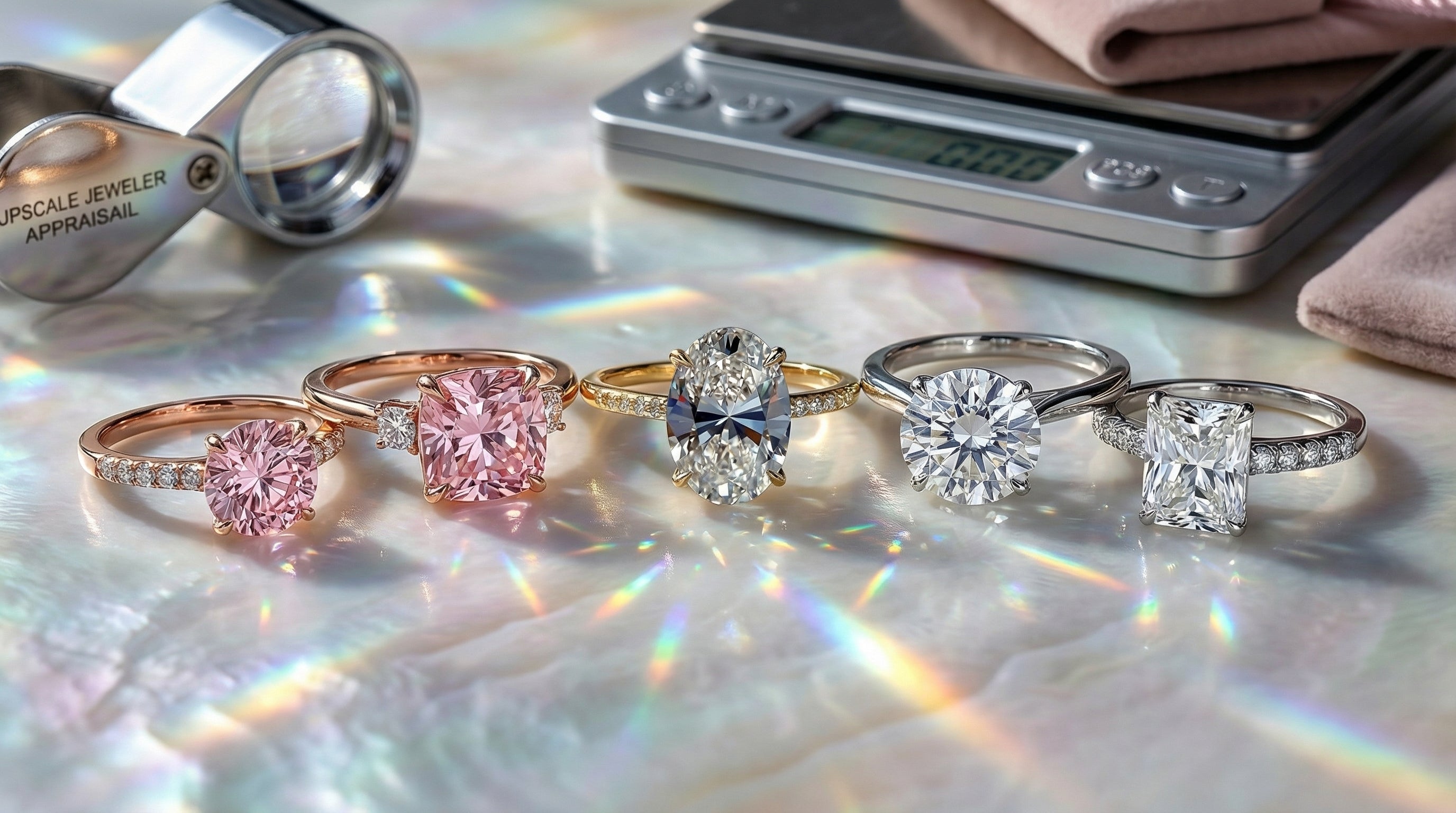
If you've spent more than ten minutes researching the 1 carat diamond ring price, you already know the numbers are all over the place. One retailer quotes $3,500. Another wants $18,000 for what looks like the same ring. And Tiffany? Don't even ask. This article cuts through the noise with a direct, side-by-side breakdown of what you're actually paying for—and what you're not—so you can walk into this decision with your eyes wide open.

Understanding the 1 Carat Diamond Ring Price in 2026
The average 1 carat diamond ring price in the USA ranges from $2,000 to over $20,000 for a natural stone. That massive gap comes down to cut quality, color grade, clarity, and where you buy it. Understanding these variables is your first line of defense against overpaying.
Walk into a traditional jewelry store and ask for a 1 carat real diamond ring. The salesperson will present you with options that look remarkably similar to the untrained eye but carry wildly different price tags. Here's the thing—the 1 carat diamond cost isn't a fixed commodity price like an ounce of gold. It's a highly subjective valuation built on a complex grading system and decades of carefully managed market perception. In 2026, the average couple spends around $7,300 on an engagement ring, but that number masks a massive divide in how people are actually allocating their budgets.
The natural 1 carat diamond price is driven by rarity. The earth produces far fewer large, flawless stones than small, included ones, so the price jumps exponentially as you climb the quality ladder. A completely colorless, internally flawless stone can push past $15,000. A stone with noticeable yellow tints and visible carbon inclusions might sit at $2,500. The secret the industry rarely volunteers? That "perfect" diamond is often visually indistinguishable from a "very good" diamond once it's set in a ring and worn on a finger.
The retail environment adds another layer of cost. A ring purchased in a high-end boutique carries the weight of expensive commercial rent, celebrity endorsement campaigns, and commissioned sales staff. Direct-to-consumer brands have disrupted this model, but even online, the markup on natural diamonds stays substantial. Knowing the mechanics behind the pricing is non-negotiable before you hand over your credit card.
The 4Cs and How They Impact Your 1 Carat Diamond Price
A natural 1 carat diamond price is dictated by the 4Cs: Cut, Color, Clarity, and Carat weight. Cut determines the stone's sparkle, while color and clarity grades dictate how flawless the gem appears to the naked eye. Mastering these four metrics is what separates a savvy buyer from an overpaying one.
The Gemological Institute of America (GIA) established the 4Cs to create a universal language for diamond quality. All four matter—but they don't impact visual beauty equally. Here's how each one moves the price tag.
Cut: The Architect of Sparkle
Cut is the single most critical factor in a gemstone's beauty, and it's the most misunderstood. It doesn't refer to the shape of the stone—oval, pear, princess. It refers to how expertly the gem cutter has angled the facets to interact with light. An Excellent or Ideal cut stone bounces light from facet to facet and back up through the top of the ring, creating that blinding, breathtaking brilliance. A poorly cut stone leaks light out of the bottom and sides, leaving you with a dull, lifeless appearance. Never compromise on cut to save money. A smaller, perfectly cut stone will always outshine a larger, poorly cut one.
Color: The Premium for Purity
Diamond color is graded on a scale from D (completely colorless) to Z (noticeably yellow or brown). The price difference between a D and an H color diamond runs into the thousands. And honestly? To the naked eye—especially when set in yellow or rose gold—an H or I color diamond looks virtually identical to a D. You're paying a massive premium for a microscopic absence of color that only a gemologist with specialized lighting can detect. Smart buyers drop to the G, H, or I range to maximize their budget without sacrificing a single point of visual beauty.
Clarity: Seeing Past the Imperfections
Clarity measures the tiny natural imperfections—inclusions—trapped inside the stone during its formation. The scale runs from Flawless (FL) to Included (I3). Paying for a Flawless or Internally Flawless diamond is almost always an unnecessary expense. A Very Slightly Included (VS1 or VS2) or even a Slightly Included (SI1) diamond is typically eye-clean, meaning you can't see the imperfections without a jeweler's loupe magnifying the stone ten times. Dropping your clarity grade to an eye-clean VS2 slashes your 1 carat diamond cost significantly—often by $1,000 or more.
Carat: The Weight of Expectations
Carat is a measurement of weight, not physical size. One carat equals 200 milligrams. Because large diamonds are exponentially rarer than small ones, the price jumps dramatically at full-carat marks. A 1.00 carat diamond costs significantly more than a 0.95 carat diamond, even though the visual size difference is less than a millimeter. This is why many buyers go "buy shy"—seeking stones just under the magic 1.00 mark to secure a meaningfully better deal.
1 Carat Diamond Price Chart: Natural vs. Lab vs. Moissanite
Our 2026 1 carat diamond price chart reveals stark contrasts across gemstone types. Natural diamonds average $5,000 to $12,000. Lab-grown alternatives hover around $800 to $2,500. Premium moissanite delivers identical visual volume and superior fire for just $200 to $500—making it the most compelling value in fine jewelry today.
To truly understand your options, you need to see the numbers side by side. The jewelry market has expanded far beyond mined stones, offering alternatives that deliver breathtaking beauty without the financial devastation. If you want to go even deeper on the economics, our detailed breakdown of moissanite vs diamond pricing covers the full picture.
| Gemstone Type (1 Carat Equivalent) | Average Price Range (2026) | Brilliance & Fire (Refractive Index) | Durability (Mohs Scale) | Sourcing |
|---|---|---|---|---|
| Natural Diamond | $4,000 - $12,000+ | 2.42 (High Brilliance) | 10 (Maximum Hardness) | Mined from the Earth |
| Lab-Grown Diamond | $800 - $2,500 | 2.42 (High Brilliance) | 10 (Maximum Hardness) | Created in a Laboratory |
| Premium Moissanite | $200 - $500 | 2.65–2.69 (Superior Fire & Brilliance) | 9.25 (Excellent for Daily Wear) | Ethically Lab-Created |
This 1 carat diamond price chart highlights a crucial reality for modern couples. You no longer have to sacrifice size or visual impact to stay within a reasonable budget. Moissanite rewrites the rules entirely. With a refractive index of 2.65–2.69 versus a diamond's 2.42, and a dispersion rating of 0.104—that's 2.4 times higher than a diamond's 0.044—moissanite bends and scatters light more aggressively, producing those signature rainbow flashes that catch the eye from across the room. By choosing a GRA-certified, lab-created gemstone with superior optical properties, you keep your financial freedom intact while wearing a ring that commands attention.

The Heritage Retailer Premium: Is a Tiffany Engagement Ring Worth It?
A 1 carat Tiffany engagement ring typically starts around $9,000 and can exceed $26,000. You're paying a substantial premium for the iconic blue box, brand heritage, and retail overhead—not for the intrinsic quality of the stone itself.
There's an undeniable romance attached to legacy jewelry houses. The velvet boxes, the champagne during your consultation, the century-old brand story—it creates a deeply emotional purchasing experience. But when you strip away the marketing and look purely at the gemstone and the metal, the math becomes hard to justify. A Tiffany engagement ring carries a markup that ranges from 50% to over 100% compared to a stone of identical GIA grading sold by a direct-to-consumer brand.
When you buy from a heritage retailer, you're funding prime real estate on Fifth Avenue, celebrity endorsement campaigns, and a massive corporate infrastructure. The stone doesn't sparkle any brighter because it came from a famous store. In 2026, savvy consumers are recognizing that the true value of an engagement ring lives in the quality of the materials and the love it represents—not the logo stamped inside the band.
Shifting your focus to premium direct-to-consumer brands means your budget goes directly into the ring itself. A larger center stone. A more intricate setting. Or simply thousands of dollars back in your savings account for your wedding, a home down payment, or a spectacular honeymoon. That's the modern definition of luxury: intelligent, informed choices that align with your actual financial goals.
Why Moissanite is the Smartest Alternative to a 1 Carat Real Diamond Ring
Moissanite is a visually stunning, highly durable alternative to a 1 carat real diamond ring. With a refractive index of 2.65–2.69, a Mohs hardness of 9.25, and ethical lab creation, it delivers more fire and brilliance than a diamond at a fraction of the cost—and it's backed by GRA certification for complete peace of mind.
If you're suffering from sticker shock after researching the 1 carat diamond ring price in USA, moissanite is the revelation you've been waiting for. Originally discovered in a meteorite crater by Dr. Henri Moissan in 1893, natural moissanite is extraordinarily rare. Today, scientists recreate this celestial gemstone in controlled laboratory environments, producing stones that are ethically sourced, environmentally responsible, and optically spectacular.
Does moissanite look "fake"? Not even close. Its higher refractive index means it bends light more efficiently than a diamond, producing a mesmerizing display of fiery, rainbow scintillation. Watch light dance through moissanite facets in direct sunlight and you'll see what we mean—it erupts with color in a way that stops people mid-sentence. Many of our 250,000+ customers tell us they actually prefer the vibrant fire of moissanite over the cooler, white-light brilliance of a traditional diamond.
Durability matters for a ring worn every single day. At 9.25 on the Mohs scale, moissanite is second only to a diamond—harder than sapphires, rubies, and emeralds. It won't scratch, cloud, or lose its brilliance over time. It's a true forever stone. And if you're curious how it holds up to professional scrutiny, our guide on whether moissanite passes a diamond tester reveals just how closely it mirrors a mined diamond's physical characteristics.

Sizing Up: The Jump to a 2 Carat Diamond Ring
Upgrading to a 2 carat diamond ring doesn't double your cost—it often triples or quadruples it, because larger natural stones are exponentially rarer. Choosing moissanite lets you wear a massive, flawless 2 carat centerpiece without the financial strain that comes with a mined stone of that size.
Once you start trying on rings, a predictable thing happens: "carat shrinkage." What looked massive in the display case suddenly feels modest on your hand. Many couples who start out looking for a 1 carat stone quickly find themselves eyeing a 2 carat diamond ring. But the pricing math is brutal. A high-quality 2 carat natural diamond runs between $15,000 and $40,000. That's not a typo.
This is where moissanite's true power becomes undeniable. Because it's lab-created, the price scales linearly—not exponentially. The cost to produce a 2 carat moissanite is only marginally higher than a 1 carat stone. That means you can upgrade from a 1 carat to a breathtaking 2 carat, 3 carat, or even a 5 carat showstopper for just a few hundred dollars more. If you're torn between sizes, our guide comparing 1 carat vs 2 carat moissanite rings will help you visualize the difference and choose the right fit for your hand shape and lifestyle.
Our Top Recommendations for Brilliant 1 Carat (and Larger) Rings
Finding your dream ring means balancing breathtaking sparkle with intelligent pricing. We've curated a selection of our most spectacular moissanite rings—each one delivering the luxurious look of a flawless diamond without the inflated retail markup.
At Awareness Avenue, we believe everyone deserves to wear a masterpiece. Our moissanite engagement rings are crafted with the same precision, premium metals, and attention to detail as the world's most expensive heritage brands—and every stone comes GRA certified. Here are our absolute favorite pieces that prove you don't need to spend a fortune to secure a breathtaking symbol of your love.
The Classic 1 Carat Choice
If you want the perfect balance of everyday wearability and undeniable elegance, The Opaline 1CT Moissanite Ring is a flawless starting point. The oval cut elongates the finger while maximizing the stone's surface area, making it appear larger than its carat weight suggests. It catches light beautifully at every angle—a timeless silhouette that will never go out of style.
Stepping Up to 2 Carats
For those who want more presence on the hand, The Opaline 2CT Oval Cut Moissanite Engagement Ring delivers spectacular volume. The two-carat size is rapidly becoming the new standard for modern brides in 2026—large enough to be a genuine statement piece, yet perfectly proportioned for daily wear. The fire that erupts from this stone in direct sunlight is genuinely mesmerizing.

The Minimalist Dream
Sometimes less is more. The 0.5CT Six Prong Moissanite Ring is a masterclass in understated elegance. Six prongs secure the stone while allowing maximum light to enter from every angle. It's a delicate, whisper-quiet declaration of love that pairs beautifully with intricate wedding bands—or stands proudly on its own.
Vintage Romance Meets Modern Brilliance
If you love the softened, romantic look of antique jewelry, the 4CT Cushion Cut Halo Moissanite Ring is breathtaking. Rounded corners and larger facets create a chunky, brilliant scintillation. Surrounded by a delicate halo of smaller stones, this ring delivers massive finger coverage and a distinctly regal aesthetic that photographs like a dream.
The Ultimate Showstopper
For the bride who wants to stop traffic, the 5CT Radiant Cut Solitaire Moissanite Ring is an absolute triumph. The radiant cut combines the elegant geometry of an emerald cut with the brilliant facet pattern of a round stone. At five carats, this ring is a bold, fearless statement. And because it's moissanite, this level of opulence is entirely accessible—no six-figure price tag required.

A Touch of Color
Modern engagement rings are breaking free from traditional clear stones. The Camilla 2CT Pink Moissanite Ring offers a soft, romantic blush tone that's genuinely one-of-a-kind. Want to push further? The Camilla 5CT Pink Moissanite Ring delivers that same gorgeous rosy hue in a massive, unforgettable size. Pink moissanite is the perfect way to express a love story that's anything but ordinary.
Frequently Asked Questions
Navigating the fine jewelry market raises plenty of questions. We've compiled the most common ones about pricing, gemstone alternatives, and smart shopping strategies to help you make a confident, informed decision for your forever piece.
How much should I really spend on a 1 carat ring?
Spend exactly what you're comfortable with—without going into debt. The old "three months' salary" rule was a marketing invention by the diamond industry, not a financial best practice. In 2026, you can spend $5,000 on a natural diamond, $1,000 on a lab diamond, or $300 on a premium moissanite ring that looks identical to the naked eye. Choose the option that aligns with your financial goals, not a decades-old advertising slogan.
Does a 1 carat moissanite look exactly like a 1 carat diamond?
To the naked eye, they look strikingly similar—but moissanite has more fire. Its dispersion rating of 0.104 is 2.4 times higher than a diamond's 0.044, which means it throws off more colorful flashes of light compared to a diamond's white-light brilliance. Most people can't tell the difference without specialized equipment, and many of our 250,000+ customers actively prefer the vibrant, lively sparkle of moissanite.
Why is the 1 carat diamond price so variable?
The price fluctuates based on the 4Cs (Cut, Color, Clarity, Carat) and the retailer's markup. A flawless, colorless diamond sold at a luxury boutique costs ten times more than a slightly included, near-colorless diamond sold by an online retailer—even though both are technically 1 carat natural diamonds. The stone's grade and the store's overhead both drive the final number.
Will a moissanite ring hold up to daily wear?
Without question. Moissanite scores 9.25 on the Mohs hardness scale, making it one of the hardest substances on earth. It's resistant to scratching, chipping, and breaking. Unlike cubic zirconia, it won't cloud over time—its brilliance is guaranteed to last a lifetime. Every Awareness Avenue moissanite ring comes with a lifetime warranty and GRA certification to back that promise up.
Your Next Steps to Finding the Perfect Ring
Your engagement ring should be a symbol of your unique love story—not a source of financial stress. By understanding what actually drives the 1 carat diamond ring price and exploring brilliant alternatives like moissanite, you can secure a breathtaking ring that aligns with your values and your budget.
You're now equipped to see past the marketing hype and the inflated price tags. You understand how the 4Cs manipulate costs, why heritage brands charge a premium, and how moissanite—with its superior fire, 9.25 Mohs hardness, and ethical lab creation—offers a genuinely compelling alternative. The days of compromising on size or quality because of an arbitrary diamond pricing structure are over.
We invite you to explore our full collection of engagement rings and see these brilliant stones for yourself. Whether you're drawn to a classic solitaire, a vintage-inspired halo, or a massive radiant cut, your perfect ring is waiting. Browse our best sellers today and discover how easy it is to wear the luxury you deserve—backed by our 30-day returns, secure checkout, and a lifetime warranty that means it.

Leave a comment
This site is protected by hCaptcha and the hCaptcha Privacy Policy and Terms of Service apply.