


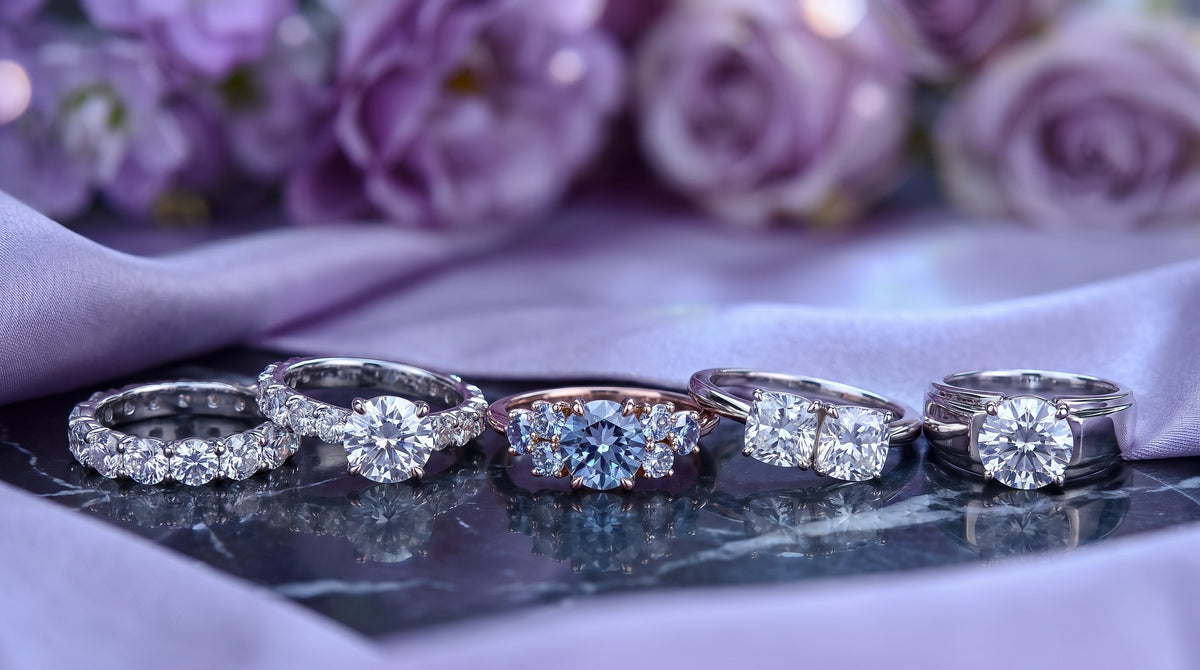
Here is the detail most price comparisons skip: the stone in a "2 carat" moissanite ring almost never weighs two carats. Moissanite is less dense than diamond, so a stone cut to the same physical dimensions weighs roughly 15% less. A 6.5 mm round diamond weighs about 1.00 ct; a 6.5 mm round moissanite of the same proportions weighs closer to 0.88 ct, yet it is sold as a "1 carat" stone because that is what it looks like on a hand. Scale that convention up and a "2 carat" moissanite is a stone measuring roughly 8 mm across in a round cut — diamond-equivalent weight (DEW), not literal carat weight.
That one piece of vocabulary changes how you read every price tag. You are not buying two carats of material; you are buying 8 mm of visual presence. And because the gem itself is a modest share of the final cost at this size, the number you see at checkout is driven far more by the metal, the setting complexity, and the retailer's positioning than by the stone. That is why you can find a 2 carat moissanite engagement ring for under $100 on one site and over $2,000 on another without either being a scam.
What Drives the Price of a 2 Carat Moissanite Ring
Four variables account for nearly the entire spread between the cheapest and most expensive 2 carat moissanite rings on the market.
1. The metal and whether it is solid or plated
This is the largest single lever. Sterling silver is inexpensive and soft; solid 14K gold costs materially more per gram and behaves very differently over years of wear. Many budget rings use sterling silver with a thin layer of 18K white gold plating to mimic the look of white gold, which is why they can carry a large stone at a very low total price.
2. Stone tier and branding
Specialist moissanite retailers such as Charles & Colvard quote loose moissanite in the region of $300–$1,000 per carat depending on quality and size, with premium named-brand material (colorless D–F grades from established moissanite houses) sitting at the top of that band and unbranded or budget material well below it. Translated to 2 carat equivalents, independent pricing guides such as Tashvi.ai commonly put the loose stone itself somewhere between roughly $800 and $1,200, while brand-name colorless stones can reach the $2,000 end of the range. Unbranded material sold in bulk goes far lower, with more variability in cut precision and color consistency.
3. Setting complexity
A plain solitaire costs less to manufacture than a hidden halo, a pavé shank, a three-stone layout, or a bridal set with a matching band. Multi-ring sets and heavily detailed designs push the same center stone size into a higher bracket.
4. Retail channel and discount framing
Mass marketplaces, department stores, direct-to-consumer brands, and specialist moissanite jewelers all target different margins. Department stores in particular often show a high "regular" price with a deep markdown and a stacking coupon, which makes the reference price a weak guide to what anyone actually pays. Judge value by the price you can transact at today, not by the struck-through number beside it.
Typical Price Bands for a 2 Carat Moissanite Ring
The ranges below summarise prices documented during 2026 research across mass marketplaces (Amazon, Walmart), department-store jewelry catalogs (Kohl's), direct-to-consumer brands, and specialist moissanite retailers (Charles & Colvard, Best Brilliance), cross-checked against independent benchmark guides. They are snapshots, not quotes: jewelry pricing moves with metal costs and promotions, so always confirm the live figure on the product page before you budget.
| Tier | Typical configuration | Commonly observed range | Main trade-off |
|---|---|---|---|
| Mass marketplace | 925 sterling silver, often 18K white gold plated, round 8 mm center, CZ accents | Roughly $80–$150 | Plating wear, limited brand assurance, variable cut quality |
| Mid-market / direct-to-consumer | Sterling silver or plated silver, branded design, stated color and clarity grades | Roughly $250–$700 | Softer metal than gold; design-led rather than gem-led pricing |
| Mixed moissanite and diamond accents | 2 ct moissanite center with small natural diamond melee | Roughly $600–$900 at typical promotional pricing | Accent diamonds add cost without adding visible size |
| Specialist moissanite in solid gold | 14K gold solitaire or halo, branded colorless or near-colorless stone | Roughly $1,000–$2,000 | Higher upfront cost; best long-term wear |
| Premium design-led gold pieces | Elaborate settings, bridal sets, split shanks | Can reach roughly $3,000–$4,000 | You are paying for design and metal, not stone size |
Two observations are worth sitting with. First, the gem is the least variable part of the equation: a well-cut 8 mm moissanite looks broadly similar at $90 and at $1,400. Second, the price you pay buys longevity in the setting, not extra sparkle in the stone. If you want to understand how that plays out across metals specifically, our comparison of moissanite in gold versus silver settings covers the practical differences in more depth.
How 2 Carat Moissanite Compares to Lab-Grown and Natural Diamonds
Against natural diamond, the gap is enormous
At the 8 mm size class, a natural diamond of comparable dimensions and reasonable quality is typically quoted in the tens of thousands of dollars for the stone alone. Benchmark tables published by the independent guide Tashvi.ai place 2 carat natural diamonds in roughly the $20,000–$40,000 band depending on color, clarity, and cut; these are secondary compilations rather than an official price index, and natural diamond pricing shifts with grade and market conditions. Against that benchmark, a 2 carat moissanite ring in the hundreds, or even at the top of the solid-gold band, represents savings on the order of 80–95%. This is the comparison moissanite marketing leans on, and on the published numbers it holds up.
Against lab-grown diamond, the gap narrows considerably
This is where shoppers are often surprised. In one documented like-for-like configuration recorded by the jewelry guide RingReel on 18 September 2026, the same 14K white gold solitaire came to $1,095 with a 2 carat-equivalent moissanite and $1,420 with a 2 carat IGI-graded lab-grown diamond — a difference of about $325, or roughly 23% less for the moissanite. Comparisons of this kind generally land in the 20–30% range rather than an order of magnitude, and in that same documented setting the gap was slightly narrower at 1 carat (about 18%). So if your decision is moissanite versus lab-grown diamond, price is a real factor but rarely a decisive one; optical character and personal preference matter more.
Resale: plan for zero
There is no reliable published secondary market data for moissanite in the sources reviewed for this guide. As independent guide RingReel notes, no named, dated source publishes resale values for moissanite, which means the only honest answer to "what is it worth" is "what a seller charges for it today." Treat a 2 carat moissanite ring as a stone you buy to wear, not an asset you expect to liquidate. Major jewelers like Blue Nile are explicit that moissanite is less valuable than diamond, and nothing in the available evidence supports investment-style framing.
What You Actually Get at 8 Millimeters: Sparkle, Clarity, and Wear
Expect more fire than a diamond — noticeably more
Moissanite has slightly higher brilliance than diamond and more than twice its dispersion, which is the property that produces rainbow flashes. The Gemological Institute of America notes that in sizes of one carat and above, that intense fire can reveal moissanite as a non-diamond gem, and in very large stones the effect is sometimes described as a "disco ball" look. Independent buyer's guides make the same point: above roughly 1.5–2 carats, the dispersion becomes obvious to a trained eye across a room.
Whether that is a feature or a flaw is genuinely a matter of taste. Many buyers choose moissanite precisely because it throws more color. If your goal is a stone that reads as diamond under every lighting condition and every level of scrutiny, 2 carats is the size at which moissanite starts to announce itself. If you are weighing presence against subtlety, our side-by-side look at 1 carat versus 2 carat moissanite is a useful next read.
Clouding is a myth; residue is not
According to Brilliant Earth's gemstone guidance, moissanite does not become permanently cloudy, does not tarnish or discolor, and does not absorb oils or moisture in a way that degrades clarity over time. When a moissanite looks hazy, the cause is almost always removable surface buildup: hand lotion, soap film, cosmetics, or mineral deposits from hard water. A soft brush, warm water, and mild soap restore it. Some stones do carry faint yellow or green undertones by nature, and lighting influences perceived color, but that is a characteristic of the individual stone at purchase rather than something that develops later.
Durability: the gem is not the weak point — the metal often is
Moissanite is silicon carbide with a hardness of about 9.25 on the Mohs scale, just below diamond's 10, and resists scratching and chipping well enough for daily engagement ring wear. The realistic wear question at low price points is the band, not the stone. Sterling silver is a soft metal and will scratch and show wear faster than gold or platinum under daily use. Where sterling silver is plated with 18K or 14K white gold — the standard construction for sub-$150 rings carrying an 8 mm stone — a materials review by VintageVinylNews estimates the plating commonly holds up for about 6 to 12 months of daily wear before fading begins at contact points (some accounts in that review extend the window to around 18 months), after which the silver beneath is exposed and tarnishes more readily. These are review-based estimates rather than laboratory wear testing, and real-world results vary with plating thickness and habits. The same review notes that solid gold removes the issue: it does not fade or tarnish, and a jeweler can resize it conventionally.
Reading a 2 Carat Moissanite Price Tag Without Getting Misled
"D color, VVS" appears at every price level
Grade descriptors borrowed from diamond grading show up on $80 marketplace listings and $1,500 specialist rings alike. Moissanite is not graded by an independent laboratory in the same standardized, universally enforced way natural diamonds are, so these descriptors are most useful as a statement of intent rather than a verified comparison across sellers. Where a stone carries a named brand or a specific cut certification, that is a stronger signal than an unattributed grade string.
Compare millimeters, not carats
Because moissanite is sold by diamond-equivalent weight, two listings both labeled "2 carat" can differ in actual millimeter spread, particularly across fancy shapes where the same weight can be cut shallower or deeper. Ask for, or look for, the millimeter dimensions. For round cuts, approximately 8 mm is the benchmark for a 2 carat equivalent.
Know the labeling rules
U.S. Federal Trade Commission guidance requires that simulated or imitation diamonds be clearly described as such — with a qualifier like "imitation" or "simulated" immediately preceding the word "diamond" — and distinguished from both mined and laboratory-grown diamonds. The same guidance notes that older thermal testers used to separate diamond from cubic zirconia may not correctly identify moissanite, which is why jewelers need newer testers or alternative methods. Be skeptical of any seller that markets moissanite on the basis that it will "pass" as a diamond; that framing sits on the wrong side of both the guidance and good faith.
Treat deep discounts as marketing, not valuation
Struck-through "regular" prices in the four figures beside sale prices in the low hundreds are common in this category. The useful number is the one you can pay. Compare transaction price to transaction price across retailers, holding metal, setting, and stone size constant.
Matching Your Budget to Real Use Cases
Under $150: proposal rings, travel rings, and trying the look
At this level you are buying a plated sterling silver band with a genuine 8 mm moissanite. It is a legitimate way to test whether 2 carats suits your hand before committing, to have a stand-in for a surprise proposal, or to own a piece you can wear on holiday without anxiety. Expect to replate or accept visible wear within roughly the first year of daily use.
$250–$700: everyday wear with design intent
The mid-market band buys better finishing, more considered design, stated stone specifications, and a brand you can contact. Sterling silver remains common here, so the maintenance expectations are similar, but build quality and stone consistency are typically a step up. Multi-ring sets and matching bands usually land in this range too.
$1,000–$2,000: solid gold, built to stay
Solid 14K gold removes plating from the equation, holds prongs securely over decades, and resizes cleanly. At this level you are paying for the ring to outlast the trend cycle. If you are deciding between a silver and a white gold version of the same design, our guide on choosing between sterling silver and white gold moissanite rings walks through the cost-versus-longevity math.
A practical heuristic
Decide the metal first based on how the ring will be worn, then let the stone size follow your budget — not the other way around. A 1.5 carat moissanite in solid gold will typically serve a daily wearer better over ten years than a 2 carat moissanite in plated silver at the same price, even though the second one photographs bigger today.
Where Awareness Avenue Sits in the Price Landscape
Our 2 carat designs sit in the accessible-luxury middle of the market: above mass-marketplace listings in finishing and design, below specialist solid-gold solitaires in price. To put that in concrete terms, catalog pricing recorded during research included a 2CT round cut men's moissanite ring at $399.95, a three-piece 2-carat moissanite eternity ring set at $349.95, and at least one solid-gold design priced around $1,400 — spanning the mid-market band through the lower end of the solid-gold specialist tier described above. Those were the figures on the day they were captured; current pricing, metal options, and stone specifications are listed on each product page, so check there rather than relying on any published range, including the ranges in this article.
Representative 2 carat styles to compare:
- The Opaline — 2CT cushion cut pavé solitaire, for buyers who want a cushion silhouette with a detailed shank.
- 2CT round brilliant-cut eternity ring, a classic round at the 8 mm benchmark size.
- 2CT round cut men's moissanite ring, for a heavier band profile.
- The Carina 2CT brilliant blue triple stone ring, if you want color rather than colorless.
To see the full size and setting range side by side, browse the moissanite rings collection or the moissanite engagement rings edit.
How These Figures Were Sourced
Gem properties (hardness, brilliance, dispersion, behaviour at larger sizes) follow the Gemological Institute of America. Labeling and testing rules follow U.S. Federal Trade Commission jewelry advertising guidance. Clarity and clouding claims follow Brilliant Earth's gemstone education; general measurement conventions and 1 carat price context follow Blue Nile. Observed ring prices come from retailer listings at Amazon, Walmart, Kohl's, Charles & Colvard, Best Brilliance and Awareness Avenue. Comparative stone benchmarks and the dated like-for-like ring comparison come from independent guides RingReel, CaratYes, CaratWire and Tashvi.ai, which are secondary compilations rather than official price indices. Metal and plating durability estimates come from a VintageVinylNews materials review. All prices are point-in-time snapshots captured during 2026 research and should be re-checked against live listings before purchase.
Frequently Asked Questions
Is a 2 carat moissanite ring worth the money?
On a pure cost-per-millimeter basis, it is one of the most efficient ways to get an 8 mm center stone with genuine hardness and sparkle. It is not worth the money as a store of value, because there is no documented resale market. Buy it because you want to wear it.
Why are some 2 carat moissanite rings under $100?
Because the stone is the cheap part at that size and the metal is plated sterling silver rather than solid gold. The gem is real moissanite; the savings come from the band and the absence of brand overhead.
How big is a 2 carat moissanite on the hand?
Approximately 8 mm across in a round cut — the same visual footprint as a 2 carat round diamond. Fancy shapes at the same equivalent weight will read longer or wider depending on the cut's proportions.
Will people be able to tell it is not a diamond?
At 2 carats, possibly. Moissanite's dispersion is more than twice that of diamond, and GIA notes that at one carat and above the fire can reveal it as a non-diamond gem to an informed observer. Most casual observers will not notice. Sellers are required to describe moissanite honestly as a simulant rather than as a diamond.
Does a 2 carat moissanite ring sterling silver band hold up to daily wear?
The stone does. The band will scratch faster than gold, and if it is gold-plated, the VintageVinylNews materials review estimates the plating commonly starts to show wear within about 6 to 12 months of daily use. Removing the ring for washing, swimming, and applying lotion meaningfully extends that window. For a full breakdown of what silver construction means in practice, see our guide to 925 sterling silver moissanite engagement rings.
Should I choose moissanite or a lab-grown diamond at 2 carats?
If budget is the deciding factor, moissanite wins, but by a narrower margin than most people assume — in the documented like-for-like example above, about 23% on an identical ring rather than an order of magnitude. Choose moissanite if you like its extra fire and want to put more of the budget into the setting; choose a lab-grown diamond if you want the optical signature of diamond specifically and the price difference is manageable.

Leave a comment
This site is protected by hCaptcha and the hCaptcha Privacy Policy and Terms of Service apply.