


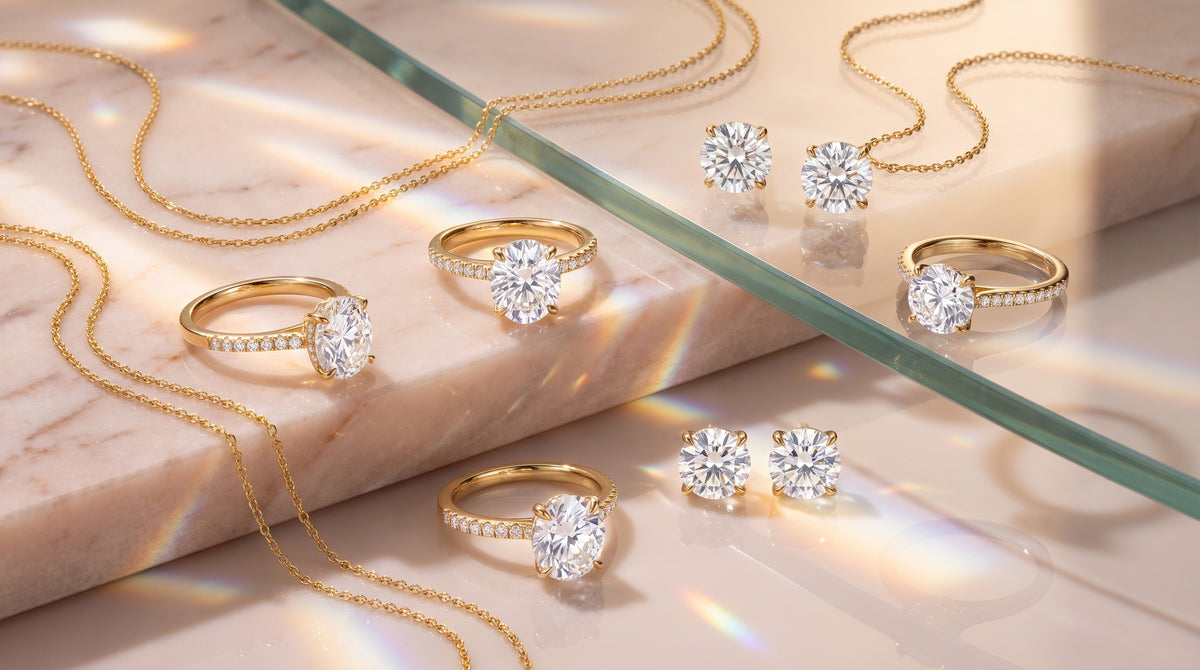
The word "affordable" does two completely different jobs in jewelry retail, and confusing them is the single most expensive mistake shoppers make. On an outlet page, affordable means the sticker was cut — Kay Outlet, for instance, brands itself as a discount jewelry destination and promotes an extra 15% off closeout pieces. On a chain store's credit page, affordable means the sticker hasn't moved at all; only the payment schedule has. Kay's credit landing page advertises zero down special financing on purchases of $300 or more, with six-, twelve-, and eighteen-month plans where interest is charged from the purchase date if the promotional balance isn't paid in full inside the window.
Same word. Two different budgets. This guide separates them, then works through eight affordable jewelry stores and store models — everyday online brands, moissanite specialists, chain outlets, and clearance sites — with the metal facts, payment terms, and review patterns that actually decide whether a cheap piece stays wearable. Every price and term below is reported as published by the brand or the outlet that documented it; promotions and APRs change, so confirm the current numbers at checkout before you commit.
First, the two budgets: sticker price vs. cost of ownership
Before comparing stores, it helps to know which of the two budgets you're actually shopping against. A $60 plated chain that needs replacing every year and a $190 solid gold chain you keep for a decade are not comparable purchases, even though one is obviously "cheaper" today.
The metal rule that quietly sets your replacement cycle
There is very little ambiguity here. As First for Women explains in its guide to non-tarnish options, real solid gold is essentially the only common jewelry metal that can be counted on not to tarnish, and in good condition it can last decades or longer. Sterling silver, copper, nickel, and plated metals including plated stainless steel will all tarnish eventually — some far more slowly than others, but none of them permanently.
This is why "tarnish-free" marketing deserves a follow-up question rather than an eye-roll: tarnish-resistant for how long, under what wear? Editorial roundups repeatedly reward brands that address this. Cosmopolitan named Abbott Lyon its top affordable jewelry brand overall, citing tarnish-free everyday pieces with personalization starting from £45, and Glamour highlights D. Louise — founded by Olivia Jenkins in 2021 — for timeless, long-lasting yet affordable design. Those descriptions reflect what buyers want; the underlying alloys and plating thicknesses are rarely published, so treat durability claims as a reason to check the return window, not a guarantee. If you want the full breakdown of which metals survive daily wear, our guide to cheap good quality jewelry goes deeper on this trade-off.
The financing rule that quietly sets your total cost
The second budget is credit. Kay's published payment options include its own credit card, Visa, Mastercard, American Express, Discover, PayPal, Venmo, Apple Pay, gift cards, Progressive Leasing, and Affirm. Special financing plans start at a $300 minimum purchase with no down payment, over six, twelve, eighteen, or thirty-six month terms; the lease purchase route also starts at $300, runs a standard twelve months, and requires an initial payment of about $79 plus tax at signing, with the rest depending on the item.
The detail that matters most is the structure. On the deferred-interest plans, Kay's disclosure states interest is charged from the purchase date if the promotional balance isn't paid in full within the promotional period — the minimum purchase is $300 for six months, $1,000 for twelve, and $4,000 for eighteen. The thirty-six-month option carries a 16.99% APR for the fixed promotional term, after which a purchase APR of 35.99% applies. Affirm, offered as an alternative, quotes rates from 0–36%, with Kay's own example showing a $700 purchase at $63.18 per month for twelve months at 15% APR. None of that is hidden, but none of it is a discount either. If a plan is the only way a piece fits your budget, you are buying the payment, not the price.
8 affordable jewelry stores and store models, compared
These are grouped by what each one is genuinely good at — everyday basics, fine and engagement rings, or discount inventory — because no single retailer wins all three.
1. Quince — solid gold basics at entry-level pricing
Business Insider's guide to jewelry brands for quality everyday pieces highlights Quince for solid gold jewelry with prices starting as low as $50. That matters because of the metal rule above: solid gold at a low entry price usually means simple, lightweight, minimalist designs rather than statement pieces. If your goal is a small hoop or thin chain you never take off, paying for solid metal in a plain silhouette is often cheaper over five years than replacing plated versions. Best for: first fine-metal purchases and stacking basics.
2. Abbott Lyon — personalization at a mid-tier price
Cosmopolitan's roundup of jewelry brands names Abbott Lyon its best affordable brand overall, describing tarnish-free everyday pieces with personalization from £45. Personalization is where cheap jewelry earns emotional value it can't earn on materials alone, and it is also the part hardest to return — engraved and custom items are commonly excluded from refunds. Check the personalization return policy before ordering, and proof the spelling twice. Best for: gifting and initial-style everyday pieces.
3. Monica Vinader — sentimental gifting with recognizable design
Harper's Bazaar includes Monica Vinader in its top five affordable jewelry brands, singling it out as best for sentimental gifts. This is the upper end of "affordable" in editorial terms: still far below traditional fine jewelers, but priced as a considered gift rather than an impulse buy. Best for: milestone gifts where recognizable design is part of the point.
4. D. Louise — newer direct-to-consumer, longevity-led positioning
Glamour profiles D. Louise as a brand founded by Olivia Jenkins in 2021 focused on timeless, long-lasting yet affordable jewelry. Newer direct-to-consumer labels tend to compete on design and durability messaging rather than store networks. The practical implication: you're buying on photos and reviews, so weight the return policy heavily. Best for: trend-aware everyday jewelry when you're comfortable buying online.
5. Charles & Colvard — the moissanite price benchmark
For anyone shopping engagement or milestone rings, moissanite is the clearest lever on price. Charles & Colvard positions its Forever One moissanite engagement rings as brilliant, ethical alternatives to diamonds, backed by a limited lifetime warranty, and its site puts moissanite at roughly $300–$1,000 per carat depending on quality and size, with a 2-carat stone in the region of $800–$2,000. Whether or not you buy from them, those figures are the most useful anchor in this entire category: they tell you what a large, well-cut lab-created stone should broadly cost, so you can spot both overcharging and suspiciously cheap listings. Best for: benchmarking center-stone pricing.
6. Awareness Avenue — handmade moissanite rings, online only
We build in the same segment as the benchmark above, so here is the honest framing. Our Luna moissanite ring is described on its product page as a handmade piece set with a 2CT oval-cut moissanite graded FL/IF in clarity, D colorless, and ideal cut, with band options ranging from vermeil to solid gold, shipped with its original GRA certificate so you can check the stone's stated grades yourself. Those are our specifications, and the band choice is the real budget dial: vermeil sits at the accessible end, solid gold at the long-term-ownership end, with the tarnish trade-off described earlier applying exactly as you'd expect.
On customer experience, Trustpilot reviewers overwhelmingly describe positive experiences — praise for craftsmanship, the stones themselves, straightforward ordering, and responsive support — while a minority report shipping delays, pieces tarnishing after a short period of wear, and occasional issues such as a missing engraving or a piece that didn't match the photos. Both halves of that picture are real, and knowing the second half is what lets you buy sensibly: choose the solid gold band if the ring is for daily lifetime wear, keep your order confirmation for engraving details, and contact support early rather than late. Browse the rest of the affordable engagement rings range, including The Celestine, if you want to compare settings. Best for: oval-cut moissanite rings bought online with certificate documentation.
7. Kay Outlet — chain closeout inventory
Kay Outlet is branded explicitly as a discount jewelry site and promotes an extra 15% off closeout jewelry. Outlet and closeout models work the same way across retail: discontinued collections, overstock, and limited remaining sizes get cleared at a markdown. The trade-off is selection — you take what's left, in the sizes that are left — and closeout items are the ones most likely to be subject to tighter return terms, so read those before buying. Best for: flexible shoppers who care more about price than picking an exact style.
8. SuperJeweler clearance — online discount fine jewelry
SuperJeweler runs a discount fine jewelry clearance category built around deal-seeking shoppers who still want fine materials rather than fashion pieces. We don't have independent quality or service data on it, so treat it as an example of the clearance model rather than a personal endorsement: compare the metal karat, stone specs, and return window against a non-clearance equivalent elsewhere before assuming the markdown is the bargain it appears to be. Best for: comparison shopping when you already know the exact specification you want.
Kay Jewelers, payments, and "near me" searches: what the evidence shows
Kay comes up constantly in affordable jewelry searches because it combines physical stores, an outlet, and heavy financing. It deserves a clear-eyed section rather than a one-line mention.
How Kay jewelry payment options actually work
Summarized from Kay's own pages: the Kay credit card offers zero down special financing on purchases of $300 or more; six-, twelve-, and eighteen-month plans are deferred-interest structures with $300, $1,000, and $4,000 minimum purchase thresholds respectively, where interest accrues from the purchase date if you don't clear the balance in time; the thirty-six-month plan runs at 16.99% APR during the promotional term and then 35.99% purchase APR. Regular credit purchases operate on a revolving basis. Lease purchase is offered from a $300 minimum with a standard twelve-month term and roughly $79 plus tax due at signing, and is marketed with no credit needed — convenient, but lease structures typically cost more in total than paying outright. Affirm is available with rates from 0–36% based on eligibility. Kay also accepts major cards, PayPal, Venmo, Apple Pay, and its own gift cards, and supports customers by phone and chat.
What reviewers report
Independent review platforms paint a difficult picture. Trustpilot shows Kay Jewelers at an overall 2.0 rating across 426 reviews, noting most reviewers were unhappy overall, with recurring complaints about product quality, stones falling out, and items not matching descriptions or online images. PissedConsumer reports a 1.7-star average from 294 reviews, with 17% of reviewers saying they'd recommend the company and 81% unfavorable, citing customer service, refunds and billing disputes, and contested warranty coverage. TopConsumerReviews similarly concludes that feedback for Kay rarely rises above two stars. Reviews are user-generated snapshots and skew toward people with problems — some reviewers do praise specific stores and staff — but the volume and consistency of the complaints are worth factoring in, particularly if you plan to rely on repairs or warranty service years after purchase.
Searching "jewelry store near me": how to vet a local branch in 20 minutes
Chain and independent stores vary enormously by location, so judge the branch, not just the banner. A fast process: read the most recent reviews for that specific address rather than the national brand; ask what the repair turnaround is and whether repairs go off-site; ask whether resizing, rhodium re-plating, or prong re-tipping is chargeable and how often it's recommended; ask for the written warranty and return policy before you discuss financing; and ask to see the stone's grading documentation in person. If a salesperson leads with a monthly payment before discussing the metal, karat, and stone, that is your cue to slow down.
Best cheap jewelry websites vs. buying in person
USA Today's shopping guide notes that while online prices aren't always lower, many online retailers run more frequent discounts and flash sales than brick-and-mortar stores. That is the core trade-off. Online you get promotional pricing, wider selection, and published specifications; in person you get to see color, scale, and finish, and you get a human to hand the piece back to if something goes wrong.
What to verify on any online jewelry store
Whatever the price, check five things before you enter card details: the exact metal description (solid gold and its karat, vermeil, sterling, or plated — vague wording like "gold-tone" tells you it isn't solid); the stone type and whether documentation ships with it; the full return window and whether personalized or clearance items are excluded; realistic shipping timelines, since delays are one of the most common complaints across online jewelry brands, ours included; and whether support is reachable before you order, not just after. Our walkthrough on how to buy jewelry online covers the documentation and security checks in more detail.
When in-person still wins
Buy in person when fit is critical and hard to reverse (wide bands and eternity styles are awkward to resize), when you're color-matching to jewelry you already own, or when you specifically want a local relationship for future repairs. Buy online when you know your size, the specification is published clearly, and the return policy is generous enough to make the risk small.
Matching the store to the purchase: a quick decision guide
If you want everyday pieces you'll wear daily
Prioritize solid metal over size. A small solid gold piece outlasts a large plated one, and the tarnish behavior of plated and base metals is a matter of chemistry rather than brand quality. Entry-level solid gold does exist — Quince's reported $50 starting point is the clearest published example — and it usually looks like restraint: thin chains, small hoops, simple studs. Our guide to building an everyday jewelry set covers how to combine a few durable staples instead of many disposable ones.
If you want a ring for a proposal or milestone
Set the center stone budget using a published benchmark rather than a store's framing. With moissanite quoted at roughly $300–$1,000 per carat by Charles & Colvard and a 2-carat stone in the $800–$2,000 range, you can evaluate any moissanite listing quickly. Then spend your remaining budget on the band metal, because that is the component that determines whether the ring survives a decade of daily wear. Pieces like The Alina and the Luna are built on exactly that logic, with the same stone available across different band materials.
If you're shopping purely on price
Outlet and clearance channels — Kay Outlet's closeout promotions, SuperJeweler's clearance category — are legitimate ways to pay less, provided you check what you're giving up: selection, sizing, and sometimes return flexibility. And if the only way an item fits is a deferred-interest plan, calculate what happens if you miss the payoff date. A plan that retroactively charges interest from the purchase date, or rolls into a 35.99% purchase APR, converts a discount into a premium.
Frequently asked questions
Is cheap jewelry always low quality?
No, but cheap usually means a compromise somewhere, and the honest question is which one. Lower price can come from simpler designs, lab-created stones instead of mined ones, thinner metal, plating instead of solid gold, direct-to-consumer overheads, or clearance inventory. The first two are compromises most people are happy to make; plating is the one with a predictable expiry date.
Does a lower monthly payment make jewelry more affordable?
Only if you pay it off within the promotional terms. Deferred-interest plans like the ones Kay discloses charge interest from the original purchase date if the balance isn't cleared in the promotional window, and lease-to-own programs typically cost more overall than paying in full. Compare the total amount payable, not the monthly figure.
Are moissanite rings a good affordable alternative to diamonds?
They're the most established one. Charles & Colvard markets moissanite as an ethical alternative to diamonds with a limited lifetime warranty on its stones, at roughly $300–$1,000 per carat. That pricing is what allows a 2-carat center stone to sit inside budgets that wouldn't stretch to a comparable mined diamond. Ask for grading documentation either way — our rings ship with their original GRA certificate, and any seller should be able to tell you what paperwork comes in the box.
Where should I actually start?
Decide which budget you're solving for. If it's daily wear, start with solid metal in a small size. If it's a milestone ring, start with the stone benchmark and choose the band metal you can afford to keep. If it's a gift, start with the return and personalization policies. Every store on this list is a reasonable answer to one of those questions and a poor answer to at least one other — which is exactly why "best affordable jewelry store" only has a useful answer once you've named the purchase.

Leave a comment
This site is protected by hCaptcha and the hCaptcha Privacy Policy and Terms of Service apply.