


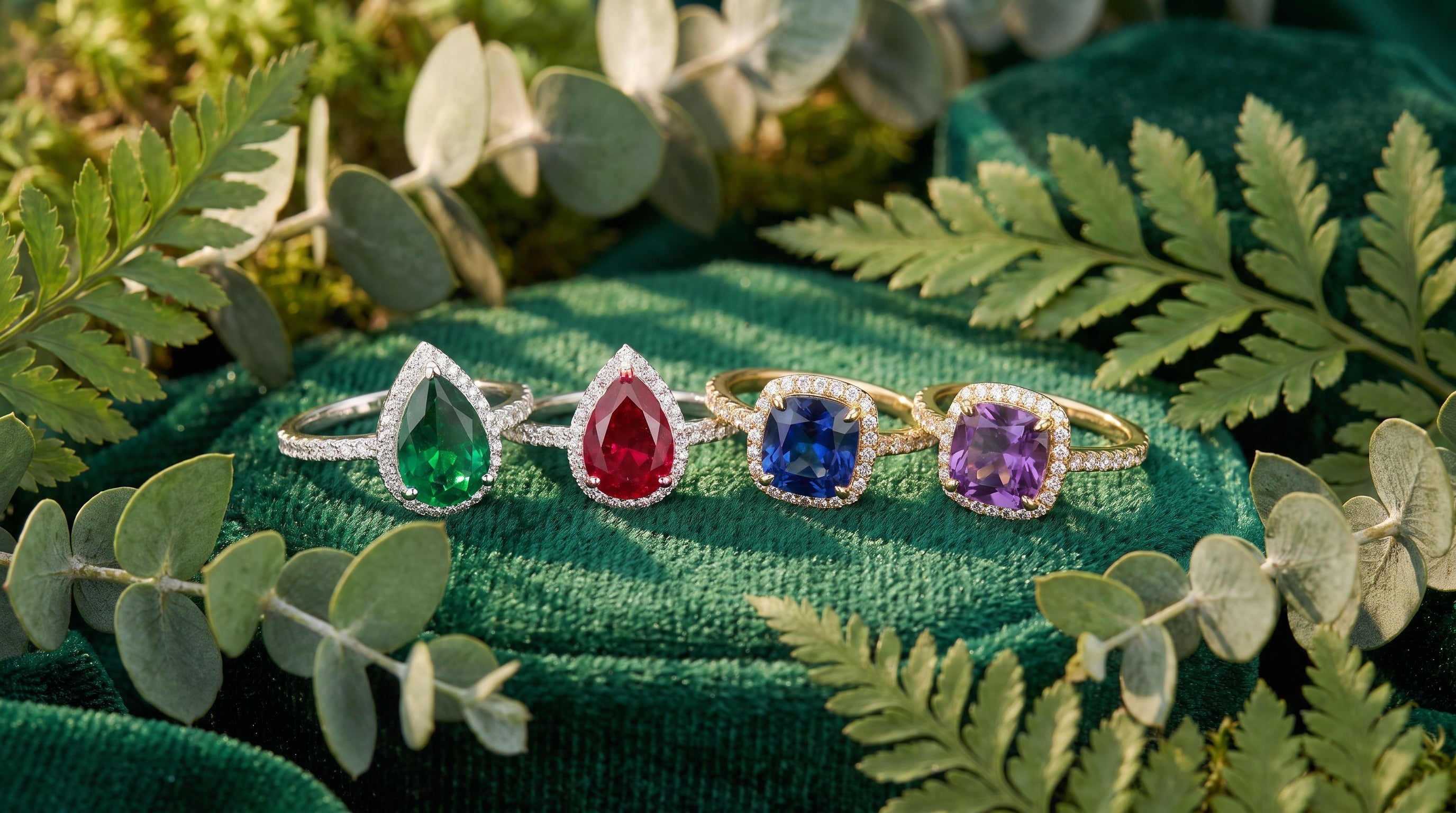
Four stones is the point where a birthstone ring stops being a piece of jewelry with a gem on it and starts being a small piece of record-keeping. One stone is a color choice. Four stones is an order: who sits at the center, who sits at the edge, whether the sequence runs oldest to youngest or by birth month, and whether there is room for a fifth person later. Every jeweler that sells this category has quietly solved that layout problem in a different way, which is why a four-stone ring from one brand looks nothing like a four-stone ring from another even when the gems are identical.
This guide is written for someone who already knows the number. You have four people to represent, and what you actually need is help deciding how those four stones should sit on a finger that will wear the ring through school runs, hand-washing, and years of ordinary life. Below, the decisions are ordered the way jewelers' own configurators order them: stone count and structure first, then layout, then personalization, then materials, then fit and longevity.
What a four-stone birthstone ring actually is
In the way the jewelry trade uses the term, a mothers ring is a symbolic piece designed to represent a mother's family, typically featuring the birthstones of her children and often including engraved names or other meaningful details. Jewlr states this definition explicitly on its mothers rings pages, and it is echoed in practice across retailers that run dedicated "Mother's Rings & Family Rings" or "Family and Mother's Jewelry" sections separate from their general ring catalogs — ArtCarved, Kay Outlet, Zales, Sparkle & Jade, and MothersFamilyRings all maintain that separation.
The practical consequence of that separation matters when you shop. A ring sold inside a family-ring category is expected to be configured by you: you assign a specific stone to a specific setting, and often a specific name to a specific engraving field. A multi-stone ring sold as fashion jewelry may use a birthstone color but carries no assumption that each gem stands for a person. Slate & Tell's birthstone stacking rings, for example, are accented with the buyer's birthstone color of choice and positioned as stacking pieces rather than as family rings. Both can be beautiful. Only one is built around representation.
Why the count is the query
Retailers advertise stone count in the product title itself because the count is what shoppers search on. Kay Outlet lists a Heart Birthstone Family & Mother's Ring supporting one to four stones and a Mother's Family Birthstone Swirl Ring in the same one-to-four range. Kay's personalized configurator carries a Mother's Family Birthstone Asymmetric Contoured Ring supporting one to five stones. Zales sells a Mother's 3.0mm Birthstone Eternity-Style Ring configurable from three to twelve stones, and a Mother's Birthstone Slant Bypass Ring fixed at three. ArtCarved offers a Mother's Ribbon Ring with two to four marquise stones alongside a four-stone family ring model.
Two structures emerge from that list, and they are the first real fork in the decision:
- Range designs (1–4, 1–5, 3–12 stones) are engineered so the same band reads correctly whether you fill two settings or five. The proportions are built for flexibility.
- Fixed-count designs (a three-stone bypass, a dedicated four-stone family ring) are composed around one specific number. The spacing, the metal between stones, and the shoulder taper were all drawn for that count, and they usually look more resolved because of it.
If your family is complete at four, a fixed four-stone design will generally sit better on the hand than a twelve-capacity ring filled halfway. If there is any chance of a fifth person, a range design or a stacking strategy is the more forgiving path. That is the trade-off in a sentence: composition versus capacity.
Who the four stones usually represent
The obvious reading is four children. It is far from the only one. Four stones commonly stand for two parents and two children, four siblings, a mother plus three children, or four grandchildren. Some buyers use the fourth stone for a spouse, a parent who has passed, or a chosen family member. The Good Trade's ring shopping guide opens with the question "What am I celebrating?" precisely because the answer changes the design — a ring marking four births reads differently from a ring marking a household of four.
Naming the four people before you shop is not a sentimental exercise. It determines the stone colors, and the colors determine which layouts will work. Four stones that happen to include two blues and two greens will look muddled in a tight cluster and excellent spaced along a band. Four high-contrast stones — a red, a green, a clear, a deep blue — carry a cluster easily. Write the four months down first.
The four layouts for four stones, and how each one wears
Multi-stone family rings on the market resolve into a handful of recurring architectures. The names differ by brand; the geometry does not.
The row
Four stones set in a straight line across the top of the band, usually in equal sizes. This is the most legible layout — each stone is separately visible, order is unambiguous, and a chronological sequence reads left to right like a sentence. Jewlr's spiral marquise row style is a variation on this idea. The cost is width: four stones in a row occupy real estate across the finger, and on a narrow hand a row can crowd the adjacent fingers. Round and marquise cuts handle rows well because they tile neatly. Pear cuts in a row need careful orientation or they fight each other.
The cluster
Four stones grouped into a compact shape — a square of four, a diamond arrangement, or a tight quartet within a frame. Kay Outlet's heart birthstone family ring and criss-cross styles show how retailers cluster stones into a recognizable motif rather than a line. Clusters keep overall width down and read as one ornament from a distance, which some wearers prefer. The downside is that individual stones lose prominence, and with four similar hues the cluster can look like a single mottled surface rather than four distinct people.
The bypass or swirl
The band splits and crosses over itself, carrying stones along the crossing lines. Zales' slant bypass construction and Kay Outlet's swirl ring both use this movement. Bypass layouts handle mixed stone sizes gracefully and give an asymmetric, more contemporary look. They also tend to have a slightly taller profile where the shanks cross, which is worth noting if the ring will be worn under gloves or during hands-on work.
The eternity or spaced band
Stones distributed around a continuous band rather than concentrated on top. Zales' eternity-style mothers ring, configurable from three to twelve stones, is the archetype. With only four stones this reads as a spaced band — gems at intervals with metal between. It is the flattest and most comfortable of the four architectures and the easiest to wear daily, but it hides some stones against the palm side of the finger, so the full set is only visible when you turn the ring.
Symmetry versus asymmetry with an even number
Four is an even number, and even numbers have no center. That is a real design consequence. A three-stone ring has an obvious focal point; a four-stone ring does not, unless the designer creates one by varying stone size or by curving the band. Kay's asymmetric contoured family ring shows one solution — placing stones along a curve so the eye travels rather than seeks a middle. Your options are essentially: accept the balanced, centerless look of four equal stones, or choose a design that deliberately weights one side. Neither is better, but going in aware of it prevents the vague dissatisfaction of a ring that feels like it is missing something.
One four-stone band, or four stacking rings?
Joy Jewelers' mothers ring buyer's guide frames the first style decision as stackable versus traditional. Stackable mothers rings are thinner bands worn in multiples on the same finger, each one able to carry a different person's stone and each one able to be added over time. Traditional mothers rings are worn alone and carry several stones within a single band.
For four stones specifically, that gives three viable routes.
The single four-stone band
One ring, four settings, one unified design. The stones were sized and spaced to work together, and the piece reads as a single considered object. It is the cleanest look and usually the most comfortable, since there is only one band's worth of thickness on the finger. It is also the least adaptable: adding a fifth person means either a new ring or a reset by a jeweler, and whether a given ring can be reset depends entirely on its construction.
Four stacked bands
Four thin rings, one stone each, worn together. This is the most future-proof configuration — a fifth band joins the stack whenever it is needed, and the wearer can choose to wear two on a busy day and all four for an occasion. The trade-offs are real: four bands are collectively thicker than one, thin stacked bands rub against each other and against neighboring fingers, and matching a fifth band's metal and finish years later is not always straightforward.
The hybrid
A three-stone or four-stone anchor band paired with one or more single-stone companions. This is the underrated option. The anchor ring carries the core group as a composed design, and additions arrive as separate slim bands that visually defer to it. If you are choosing today for a family that may grow, this preserves the look of a designed piece while leaving a clear path forward. Our three-stone birthstone ring guide covers the anchor half of that combination in more detail, and the two-stone guide is useful if the pairing is a couple rather than a family.
One caution: it is not safe to assume that any multi-stone ring can have stones added later. Some range-capacity designs are configured only at the point of order. If future additions matter to you, ask the jeweler directly whether the specific setting can be re-cut and re-set, and get the answer before you buy rather than after.
Personalization: engraving, birth months, and the errors that cost most
Personalization is where four-stone rings go wrong most often, simply because there are four opportunities for error instead of one. Joy Jewelers' guide is direct about this, advising buyers to carefully record the spelling of each family member's name and to double-check each birth month and its corresponding birthstone. That warning exists because these mistakes are expensive to fix and emotionally worse than expensive.
Build the spec sheet before you open the configurator
Write out, in the exact order you want them set, four rows: person, birth month, birthstone, and name exactly as it should be engraved. Then verify each row against something authoritative rather than memory — a birth certificate, a shared family calendar, a message from the person themselves. Nicknames are the most common engraving trap: the ring will be worn for decades, and a nickname that feels affectionate today may not age the way a given name does. Decide deliberately either way.
Understand what "birthstone" means for your month
Several months have more than one accepted stone, and different jewelers default to different ones. A birthstone that appears as one color on one site may appear as another elsewhere for the same month. Before ordering, confirm on the retailer's own page which specific stone and which specific color it will supply for each of your four months, rather than assuming a chart in your head matches theirs. If a particular shade matters — a specific green, a specific blue — ask whether the stone shown in the product image is representative of what ships.
Order and engraving fields
Decide the sequence explicitly: chronological by birth, chronological by month within the calendar year, or arranged for color balance. Chronological by birth is the most common and the easiest to explain to anyone who asks about the ring. Color-balanced ordering can look better but can also read as arbitrary later.
Engraving capacity varies widely by brand and by model, and no general rule applies. Marketplace sellers such as Fortheday and PaulaMax advertise the ability to choose any names or words for engraving on sterling silver mothers rings, but the practical limit on a slim band is set by circumference and font size, not by ambition. Four names on the interior of a narrow band is realistic; four names plus four dates usually is not. Ask for the character limit per field and whether the engraving is inside, outside, or on the shoulders before you finalize the text.
Metals, stones, and sourcing
Metal choice
Joy Jewelers treats metal selection as one of the main steps in choosing a mothers ring, and retailer catalogs bear out the standard range. Sterling silver appears across Kay Outlet's family jewelry, Sparkle & Jade's family rings (in .925 sterling silver alongside 10K and 14K gold), and Kay's personalized configurator. Slate & Tell handcrafts birthstone rings in sterling silver and 10K and 14K white, yellow, or rose gold. MothersFamilyRings sets personalized rings in 14K yellow, white, and rose gold and platinum. So the practical menu is sterling silver at the accessible end, 10K and 14K gold in the middle, and platinum at the premium end.
For a four-stone ring specifically, metal color affects legibility. White metals — sterling silver, white gold, platinum — read as neutral and let four different stone colors stay distinct. Yellow gold warms every stone it touches, which unifies a mismatched set but can flatten the difference between, say, a citrine and a topaz. Rose gold does the same more strongly. If your four stones happen to be similar in hue, a white metal will do more to keep them separate.
Note also that gold vermeil and solid gold are different constructions, and product names do not always make the distinction obvious. Check the material description rather than inferring from the color shown.
Genuine versus simulated stones
This is a real fork in the market, and it is worth understanding rather than avoiding. Joy Jewelers states that it strongly recommends genuine birthstones for each mothers ring it sells — that is a stated brand preference, not an industry standard. At the other end, some widely available mothers rings use simulated stones and say so: Fortheday's sterling silver mothers ring listings describe simulated birthstones and let buyers pick any color.
Neither option is automatically wrong for a four-stone ring, but the reasoning differs from a single-stone piece. With four gems, natural stones will vary in tone and clarity between them because natural material does. Some buyers love that — it is proof the stones are real. Others find it makes one child's stone look duller than another's, which is not a conversation anyone wants. Lab-created and simulated stones deliver consistency across all four settings. Decide which of those two values matters more to the person wearing it, then ask the jeweler to state plainly, in writing, which category each stone falls into.
Sourcing and transparency
Ethical sourcing barely features on most mothers ring product pages, which is odd given how personal the category is. The advisory content on the topic sits elsewhere. The Good Trade's ring guide tells buyers to ask where the materials came from, whether diamonds are certifiably traceable, whether metals and gemstones were harvested sustainably, and what standards apply to the workers who made the piece. On the retail side, Alexis Russell states that its jewelry features a unique selection of ethically sourced diamonds and gemstones, hand-selected for quality, character, and durability — a self-reported claim, but an example of a brand putting sourcing language in the open.
Useful questions to send a jeweler before ordering a four-stone ring: What are these four stones — natural, lab-created, or simulated? Is the metal solid or plated, and what is the karat? Where is the ring manufactured? Can you provide any documentation on stone origin? A brand that answers those clearly is telling you something about how it operates; a brand that deflects is telling you something too.
Fit, daily wear, and the years after the gift
The Good Trade's guide asks how often the ring will be worn and whether its shape and style suit the wearer's lifestyle — whether a ring worn every day will feel as at home with casual clothes as with formal ones. For four-stone family rings, that question is unusually loaded, because these are pieces people intend to never take off.
Profile height
Four stones can be set flush into the band or raised in prongs above it. Raised settings show more of each stone and catch more light. They also catch more sweaters, hair, and door handles. For someone who works with their hands, lifts small children, or wears gloves regularly, a lower-profile spaced band or a flush-set row will survive daily life better than a tall cluster. Kay's configurator lists prong setting as a specified attribute, which is a reminder to check setting type rather than assume it.
Band width and finger proportion
Four stones need horizontal room. On a longer finger, a wide four-stone row looks proportionate. On a shorter finger, the same ring can visually shorten the hand and press against the neighboring fingers when the hand is relaxed. In that case a spaced band, a compact cluster, or a stack of narrower bands distributes the same four stones more comfortably. If ordering online, measure the intended finger properly rather than guessing, and remember that a wide band typically feels tighter than a narrow one at the same nominal size.
Where it sits in the rest of her jewelry
The Good Trade also suggests thinking about future stacking and whether matching earrings or a necklace might follow. A four-stone ring worn next to an existing wedding set has to share the finger — metal color, band width, and profile height all need to cooperate. If they will sit together permanently, matching the metal is the single easiest way to make them look intentional. If the four-stone ring will be worn on the opposite hand, you have more freedom.
Some families solve the whole problem differently by moving the multi-stone piece off the hand entirely. A pendant carries four stones with fewer constraints on width and profile and doesn't compete with a wedding set. Our guide to choosing the format and setting she'll actually wear compares rings against necklaces and bracelets for exactly this reason, and is worth reading if you are buying as a surprise and unsure about ring sizing.
Care
Multi-stone rings accumulate residue in the spaces between settings — hand soap, lotion, everyday grime — which dulls the stones faster than the stones themselves wear. Gentle regular cleaning matters more for a four-stone ring than for a solitaire, and softer gemstones need more caution than harder ones. Ask the jeweler what cleaning method is safe for the specific stones in your configuration, since the answer varies by material and setting type.
When a single-stone ring is the better answer
Not every buyer searching for a four-stone ring should end up with one. There are three situations where a single well-made birthstone ring outperforms a four-stone family ring.
The recipient wears minimal jewelry. A four-stone ring is, by construction, a statement piece. If she wears one thin band and small studs and nothing else, a four-stone cluster may sit in a drawer while a single-stone ring gets worn every day. The best ring is the one that gets worn.
You are buying as a surprise and cannot verify names, months, or size. Personalized multi-stone rings are typically made to order, and made-to-order pieces with engraved names are harder to exchange than an unpersonalized ring. If you cannot confirm the details, a single-stone piece in her own birth month removes most of the risk.
You want to build the set over time. Starting with one stone and adding one per year is a legitimate strategy, and it spreads both cost and decision-making.
Awareness Avenue's own ring range is built around single-stone designs rather than configurable multi-stone family rings, so it fits the scenarios above rather than the four-setting brief. The birthstone jewelry collection is the place to start if a one-stone-at-a-time approach suits you better, and the general birthstone ring buying guide covers stone and metal selection across single- and multi-stone formats. For a stacking approach, choosing bands in a consistent metal and a consistent band width from the outset is what makes the eventual group look deliberate rather than accumulated — the same principle covered in our piece on styling multi-ring sets.
A pre-order checklist for a four-stone birthstone ring
Run through this before you place the order. Most of it takes ten minutes and prevents the two failures that actually happen: wrong details, and a ring that never gets worn.
- List the four people with birth month, chosen stone, and name spelled exactly as it should be engraved. Verify each against a document, not memory.
- Confirm the retailer's stone for each month — including which specific gem and which color it supplies, since months with multiple accepted stones vary by seller.
- Fix the order of the stones and note whether it runs by birth date, by calendar month, or by color balance.
- Choose fixed-count or range design based on whether the family is complete. Ask explicitly whether stones can be added later to that specific setting.
- Pick the layout — row, cluster, bypass, or spaced band — with the wearer's finger length and daily activity in mind.
- Decide traditional versus stackable versus hybrid, and if stacking, commit to one metal and one band width now.
- Confirm the metal: sterling silver, 10K or 14K gold, platinum, or a plated construction such as vermeil. Ask which, in writing.
- Ask whether the stones are natural, lab-created, or simulated, and whether tone will be matched across all four.
- Check setting height and band width against how the ring will actually be worn, and whether it will share a finger with an existing ring.
- Get the engraving character limit per field and the engraving location before writing the text.
- Verify the finger size properly, allowing for a wider band fitting more snugly.
- Read the change and return terms for personalized items, since engraved made-to-order pieces are commonly treated differently from stock inventory.
- Ask about sourcing — stone origin, metal composition, manufacturing location — and note how clearly the jeweler answers.
- Confirm the care method for your specific stones before the ring arrives.
Frequently asked questions
Can I add a fifth stone to a four-stone ring later?
Sometimes, and only sometimes. Some designs are sold with configurable capacity — Kay's asymmetric contoured family ring is offered from one to five stones, and Zales' eternity-style mothers ring from three to twelve — but that capacity is generally set when the ring is made. Whether an existing ring can be reset to hold an additional stone depends on its construction and on the jeweler's own workshop capability. Ask before purchase, not after a fifth child arrives.
Is four stones too many for one ring?
No, but four stones need more finger room than three. If the wearer has shorter fingers or already wears a wedding set on the same hand, a spaced band, a compact cluster, or a stack of narrower bands will usually sit better than a wide four-stone row.
Should the four stones all be the same size?
Equal sizes read as equal standing, which is what most buyers want when the stones represent children. Varying the sizes creates a focal point, which is useful because four stones otherwise have no visual center — but it also implies a hierarchy, so use it only if that reading is intentional.
What if two of the four birth months share a similar stone color?
This is common and easily managed. Separate the two similar stones in the layout rather than placing them side by side, choose a white metal so hue differences stay visible, or use a design with metal spacing between settings rather than a tight cluster. Where a month has more than one accepted stone, the alternate may also give you a usefully different shade.
Genuine or simulated stones for a four-stone family ring?
Genuine stones vary naturally in tone between settings, which some people value as authenticity and others find uneven across four gems representing four children. Lab-created and simulated stones give matched consistency. Joy Jewelers states it strongly recommends genuine birthstones for the mothers rings it sells; other sellers openly use simulated stones. Pick the value that matters to the wearer and confirm the stone type in writing.
Does a four-stone ring have to be a mothers ring?
No. Four stones can mark two parents and two children, four siblings, four grandchildren, or four significant moments. The mothers ring framing dominates the category because that is how most retailers merchandise it, but the design logic — layout, order, sizing, engraving — is identical whatever the four stones stand for.
The short version
Decide who the four stones are and confirm their months against documents. Choose between a fixed four-stone composition and a range-capacity or stacking design based on whether the family is finished. Pick a layout that matches the wearer's hand and her daily activity, not just the photo. Select a metal that keeps four different colors legible. Ask directly whether the stones are natural, lab-created, or simulated, and get the answer in writing. Then check the engraving limits and the return terms for personalized items before you press order.
Get those six things right and the ring will do the only job it has: making four people visible on one hand, every day, for a long time.

Leave a comment
This site is protected by hCaptcha and the hCaptcha Privacy Policy and Terms of Service apply.