


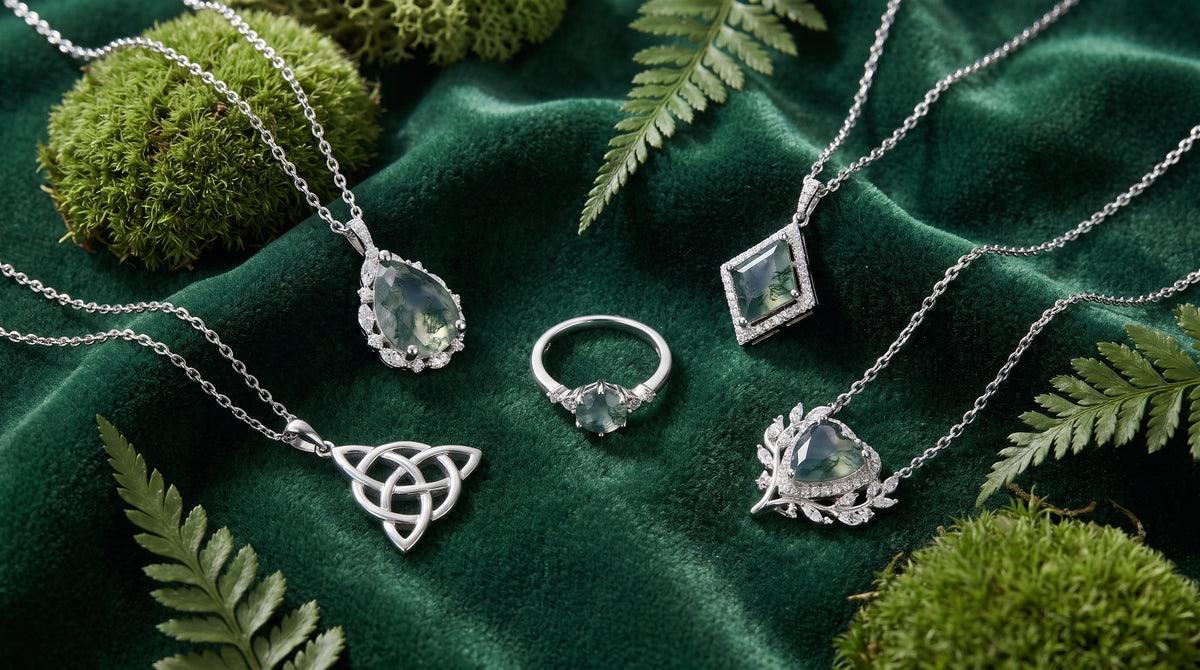
The dendritic inclusions that make moss agate worth wearing are also the reason a plain band is a structural decision, not just a style preference. Those branching green patterns are oxides of iron and manganese locked inside chalcedony, and the microscopic boundaries around them are exactly where a stone is most likely to nick. A simple moss agate engagement ring — a clean bezel or a low four-prong solitaire on a slim band — keeps the stone sitting close to the finger, reduces exposed edges, and lets the internal "landscape" do all of the visual work that a halo or a cluster would otherwise fight with. This guide treats simplicity as both an aesthetic and a protective strategy, and it is explicit about where the evidence is solid (composition, hardness, care) and where it is softer (long-term wear data, symbolism).
What "Simple" Actually Means in a Moss Agate Engagement Ring
"Simple" in this category usually describes four overlapping choices: a single center stone with no accent diamonds, a narrow or barely tapered band, a low-profile setting that sits close to the hand, and a metal finish that stays quiet rather than textured or heavily milgrained. Editorial roundups of moss agate rings repeatedly contrast ornate halos and floral or twig bands with pieces described as "simple but gorgeous" — typically an oval moss agate on a plain band, sometimes with one or two tiny side stones. Jewelers specializing in moss agate, such as Sunday Island Jewelry, lean toward soft botanical details and gentle silhouettes in part because the stone already supplies visual complexity.
There is a second, less discussed reason to go simple. Because moss agate's beauty is internal and pattern-driven rather than based on brilliance, nothing is gained by lifting the stone high off the finger to let light pass underneath, which is the usual justification for a tall cathedral or basket setting in a faceted diamond ring. Lowering the profile costs you almost no sparkle and removes a meaningful amount of snag and knock risk. If you want a broader view of minimalist construction before narrowing to engagement styles, our guide to simple moss agate rings and how to choose a minimalist design that lasts covers band widths and setting geometry in more depth.
Simple is not the same as fragile-looking
A very thin band with a very thin stone is minimal but not resilient. The most durable "simple" configuration is usually a moderately substantial band (so the shank resists bending and the setting stays tight) paired with a stone cut deep enough to resist chipping. Minimalism should show up in the absence of ornament, not in the absence of material under the stone.
What Is Moss Agate, in Plain Gemological Terms?
If you are wondering exactly what is moss agate, it is a semi-precious variety of chalcedony, a microcrystalline form of quartz with the chemical composition silicon dioxide (SiO2). Unlike banded agates, it generally lacks concentric banding. Its name comes from dendritic inclusions — mainly manganese and iron oxides — that branch through a colorless, milky white, gray, or pale bluish body and read as moss, ferns, or tiny forests. Britannica and Wikipedia both emphasize the point that trips up most first-time buyers: those inclusions are inorganic. There is no plant matter inside the stone, only mineral growth that happens to imitate one.
Most moss agate occurs as fragments weathered from volcanic rocks, with well-known sources including India, Brazil, Uruguay, parts of central Europe, and the United States. That relative abundance matters commercially: as MollyJewelryUS puts it, moss agate's value tracks the artistry of the pattern rather than scarcity, which is the underlying reason it is so consistently positioned as an affordable, nontraditional alternative to a diamond solitaire.
Why every stone is different — and how to judge one
Stuller classifies moss agate as a Type III gemstone, meaning inclusions are expected and define the stone rather than counting as flaws. GemSelect's guidance follows from that: in moss agate, the visual composition of the inclusions matters more than carat weight. When evaluating a specific stone for a simple ring, look at four things.
- Contrast. Green or dark dendrites against a clean, translucent background read as a scene; muddy or uniformly dense material reads as a smudge.
- Placement. In a minimalist solitaire, the pattern is the entire design. A stone whose interesting area sits off to one edge can look unbalanced once it is set and the bezel covers a rim of material.
- Translucency and depth. Moss agate is usually translucent rather than transparent, so thickness and orientation change how clearly the pattern reads. A deeper stone can look darker; a shallow one can look washed out.
- Visible fractures or cavities. GemSelect specifically flags structural integrity, noting that fractures, cavities, and weak areas compromise durability. These are the features that matter most in a ring.
The Honest Durability Picture: Hardness Is Only One Variable
Moss agate sits at roughly 6.5–7 on the Mohs scale, a figure repeated consistently by the International Gem Society, GemSelect, Stuller, CustomMade, The Knot, and MollyJewelryUS. That makes it harder than many household materials but clearly softer than the stones most people compare it to.
| Stone | Mohs hardness | Durability for daily wear (as rated by MollyJewelryUS) |
|---|---|---|
| Diamond | 10 | Excellent |
| Moissanite | 9.25 | Excellent |
| Sapphire / ruby | 9 | Excellent |
| Emerald | 7.5–8 | Fair (often fragile) |
| Moss agate | 6.5–7 | Good (with protective settings) |
Hardness describes resistance to scratching. It says nothing about toughness (resistance to chipping and breaking) or stability (resistance to heat, chemicals, and light), and moss agate is the kind of stone where those other two properties deserve attention. The trade blog JewelTrendPro argues that moss agate's microstructure, including microscopic fissures around dendritic inclusions, can act as stress concentrators; it reports a wear-test in which 68% of moss agate rings showed visible edge nicks or surface abrasions after six months of normal wear, compared with 12% for sapphires and 5% for diamonds, and states that 91% of surveyed wearers noticed loss of polish within four to six months. Those figures are self-reported and have not been independently replicated elsewhere in the published literature, so treat them as a directional warning rather than a precise forecast. They are, however, consistent with GemSelect's caution about fractures and with The Knot's note that moss agate is softer than some other gemstones and warrants care in daily wear.
What this means for a buying decision
A simple moss agate engagement ring is a reasonable daily ring for someone willing to adopt a few habits: removing it for workouts, gardening, cleaning, and manual work; avoiding mechanical cleaners; and accepting that a professional re-polish may eventually be part of ownership. It is a poorer fit for someone who never takes a ring off and works with their hands all day. CustomMade's advice — remove the ring while cleaning, showering, or exercising, and choose protective settings if you tend to be rough with jewelry — is the practical version of the same conclusion. For a wider objection-by-objection treatment, including resizing and replacement questions, see our complete moss agate engagement ring buyer's guide.
Settings and Shapes That Suit a Minimalist Design
Bezel: the default for simple and protective
A full bezel wraps the stone's girdle in a continuous metal rim. JewelTrendPro describes this as offering the strongest edge protection, particularly for round, oval, and cabochon cuts, at the cost of a little extra metal weight. Visually, a bezel also crops the stone like a picture frame, which suits moss agate's scenic patterns. If you want one recommendation for a simple everyday ring, this is it.
Low-profile prongs and V-prongs
Four low-set prongs keep the look airy while holding the stone close to the finger. MollyJewelryUS specifically recommends V-prongs for shapes with vulnerable points — pear, kite, marquise, hexagon — because the point is the first thing to chip. If you love a pointed outline, insist on a V-prong or a partial bezel over the tip.
Shapes, ranked by how forgiving they are
Rounded outlines without sharp corners are mechanically the safest: round, oval, and cushion. Hexagons and emerald cuts have corners that benefit from metal coverage. Kites, pears, and marquises concentrate the most stress in the least material. Market offerings from specialist jewelers cover all of these — ovals, pears, hexagons, marquises, emerald cuts, and vintage art deco-inspired shapes — so the choice is genuinely yours, but the trade-off is real. Ovals remain the most popular compromise between a generous pattern window and a forgiving outline; our dedicated guide to the oval moss agate engagement ring breaks down proportions and bezel widths for that shape.
Cabochon versus faceted
Faceting adds flashes of light at the surface but also adds edges and thin areas. A smooth cabochon or a gently domed stone has no sharp facet junctions to chip and often shows the dendritic pattern more softly. For a minimalist bezel ring, a cabochon is an underrated option.
Metal, Band Width, and Everyday Comfort
Moss agate's cool gray-green body sits comfortably with white metals, while yellow and rose tones push the green warmer and read more earthy. Specialist jewelers typically offer solid gold or platinum for engagement pieces; sterling silver is common in promise and fashion rings. Because the stone itself is the focal point, metal choice is mostly about skin tone, maintenance preference, and how much contrast you want behind the inclusions.
On band width: a 1.5–2 mm band maximizes the apparent size of the stone and is the classic minimalist proportion, but a slightly wider or thicker shank resists deformation better and keeps a bezel from loosening over years of wear. If you plan to pair the ring with a wedding band later, ask whether a straight band will sit flush against the setting, or whether you will need a contoured band. Many moss agate specialists design their rings to pair with curved or contour bands precisely for this reason; if you are shopping for both pieces together, our overview of a moss agate engagement ring set explains how matched sets handle that fit problem.
Meaning: What a Moss Agate Ring Is Said to Represent
When researching moss agate engagement ring meaning, you will find it carries a long folk reputation. The International Gem Society notes that farmers historically favored it, believing its organic appearance could help crops grow bountifully, and that the association with plenty spread into households as a stone of prosperity and good luck — the origin of its nickname, the "Gardener's Stone." Aquamarise recounts the same European field tradition and an Indian association with healing and vitality. Contemporary sellers extend this into heart-chakra language: MollyJewelryUS links moss agate's green hues to prosperity and new beginnings and describes it as encouraging emotional balance, hope, and trust, while LUO Jewelry frames it as a protective talisman suited to engagement rings.
These are cultural and spiritual beliefs, not tested physical or medical properties, and they should be read that way. What is defensible — and what makes moss agate genuinely meaningful for an engagement ring — is simpler: no two stones share the same internal pattern, so the ring is unrepeatable in a way a calibrated diamond is not. If the symbolism side interests you, our article on moss agate ring meaning and the honest trade-offs separates the lore from the gemology in more detail.
Simple Variations: Promise Rings, Vintage-Inspired, and Men's Designs
Promise rings
A moss agate promise ring appears widely in the market, often in sterling silver with vine or leaf motifs marketed as symbols of intertwined, lasting love. A simple promise ring follows the same durability logic as an engagement ring but usually at a smaller stone size, which is an advantage: smaller stones present less surface to knock.
Vintage and art deco-inspired
A vintage moss agate engagement ring — featuring geometric outlines, stepped shoulders, or fine engraving — is offered by several specialist jewelers and on resale marketplaces. They are not automatically "simple," but a clean art deco rectangle in a bezel can be both period-flavored and minimal. If the stone is antique or previously set, have a jeweler inspect it for existing fractures before resetting.
Men's moss agate rings
When looking for a moss agate engagement ring men can wear daily, flat, flush-set or inlaid stones in a wide band are the most impact-resistant moss agate construction available, which makes them a sensible answer for hands that take more punishment. See our breakdown of moss agate rings for men for setting styles and width guidance.
Care: A Routine That Keeps the Pattern Readable
Care guidance is unusually consistent across gemological and trade sources, which makes it easy to follow.
- Clean with mild soap and lukewarm water using a soft brush or cloth, then dry thoroughly — the method recommended by Stuller, the International Gem Society, GemSelect, CustomMade, and MollyJewelryUS alike.
- Avoid ultrasonic and steam cleaners. Stuller advises against both, along with abrasive polishing compounds, because mechanical energy can propagate fractures around inclusions.
- Avoid strong acids, commercial jewelry dips, and sudden temperature changes. JewelTrendPro also flags prolonged UV exposure as a risk, particularly for dyed material.
- Store separately. At 6.5–7, moss agate can be scratched by harder stones sharing a jewelry box.
- Have the setting checked periodically. Bezels and prongs loosen with wear, and a loose stone is far more likely to chip.
A Short Pre-Purchase Checklist
- Ask the seller for photographs of the exact stone in daylight, not a stock image of the style — pattern is the product.
- Ask about stone depth and whether the cut is faceted or cabochon.
- Confirm the setting type and whether points or corners are covered by metal.
- Ask whether the stone is natural or treated or dyed, since dyed material is more sensitive to light and chemicals.
- Confirm whether a matching or contoured wedding band is available if you want a set later.
- Ask the seller directly about their repair, re-polishing, resizing, and return terms before ordering, and get the answer in writing — these policies vary by jeweler and should never be assumed.
When a Pendant Is the Smarter Way to Wear Moss Agate
There is one scenario where the honest recommendation is not a ring at all. GemSelect notes that pendants and earrings are excellent uses for scenic moss agate because they protect the gem better than rings and allow a larger face-up display of the pattern. If you work with your hands constantly, dislike removing jewelry, or simply want to enjoy a large, dramatic piece of moss agate without worrying about knocks, a pendant carries less impact risk by the nature of where it sits.
That can also work alongside a ring rather than instead of one: a slim bezel-set engagement ring for the hand and a larger pendant for the pattern you fell in love with. Awareness Avenue's moss agate necklace collection includes teardrop, kite, rectangular, coffin-cut, starburst, and botanical designs in sterling silver and solid gold, which is a practical place to look if you decide a pendant suits your routine better than a ring — or if you want a complementary piece for an engagement gift.
Frequently Asked Questions
Is a simple moss agate engagement ring durable enough for everyday wear?
With a protective setting and sensible habits, yes for most wearers. Moss agate's 6.5–7 Mohs hardness supports daily wear, and multiple jewelers rate its durability as good with protective settings. But it is more prone to edge chipping and polish loss than diamond or sapphire, so it suits people who are willing to remove the ring for rough tasks and to have it maintained periodically.
Does a plain band really make the ring more durable?
Indirectly, yes. A simple design usually means a lower profile and fewer protruding elements, which reduces how often the stone takes a direct hit or snags. The setting type does the real work — a full bezel protects the girdle far better than high prongs — but minimalist designs tend to be built lower by default.
Can moss agate be resized or repaired?
Band resizing is a question for your jeweler, since heat is involved and moss agate is sensitive to thermal shock; many jewelers remove the stone first. Surface polish can often be restored professionally, but a chipped edge usually means recutting or replacing the stone — another reason edge protection matters at the design stage.
Why is moss agate less expensive than diamond?
It is relatively abundant, found in multiple regions worldwide, and its value is driven by the appeal of its pattern rather than by rarity or clarity grading. That is why it is so consistently positioned as an affordable alternative to a diamond solitaire. Actual prices vary widely by metal, stone size, and maker, so compare current listings rather than relying on general figures.
Is moss agate appropriate for a promise ring or a second ring?
It is widely sold for exactly that purpose, and the smaller stones typical of promise rings are easier to protect. The same care rules apply.
The short version: choose the stone for its pattern, choose the setting for its edges, and let the simplicity of the band be the thing that keeps both intact.

Leave a comment
This site is protected by hCaptcha and the hCaptcha Privacy Policy and Terms of Service apply.