


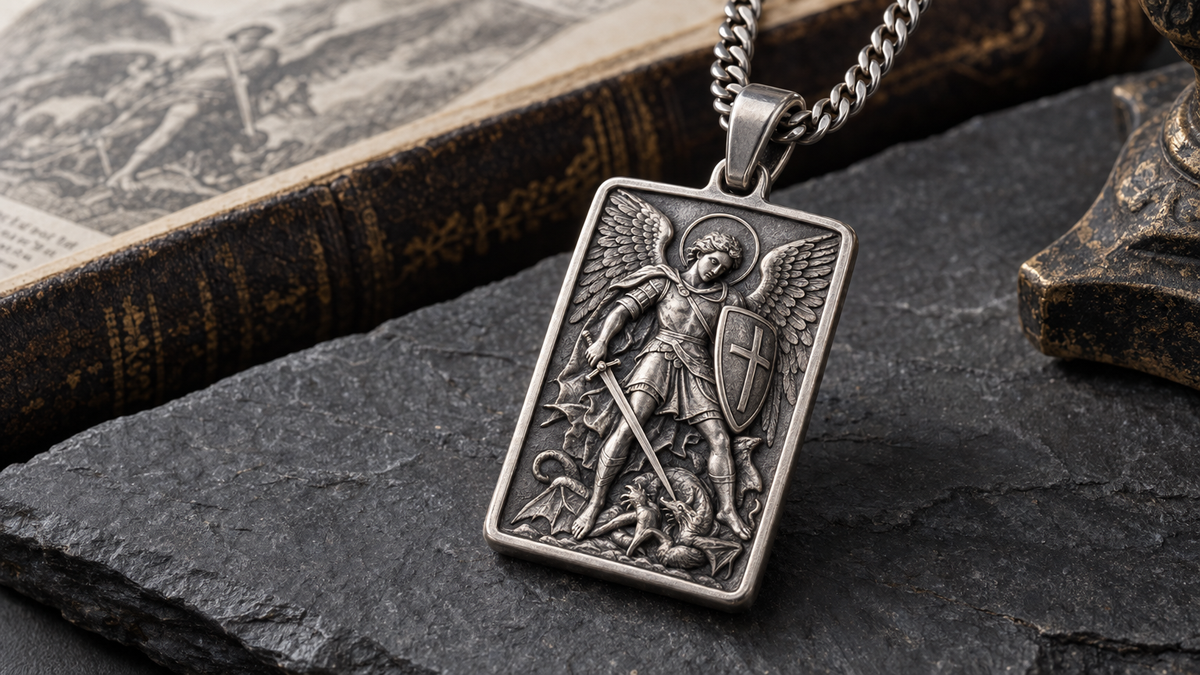
St. Michael imagery turns on a single scene, compressed into a few square centimeters of metal: a winged figure in armor, weapon raised, standing over a dragon or serpent. Armor, wings, a sword or lance and a defeated dragon are established features of Michael's iconography (Fitzwilliam Museum). That scene — not the finish, the chain or the size — is where the meaning lives. A St. Michael pendant is worn as a sign of protection, courage, faith and the victory of good over evil, because Revelation describes Michael and his angels fighting and defeating the dragon, identified there as the ancient serpent, the Devil and Satan (Revelation 12:7–9, USCCB), while Daniel calls Michael "the great prince, guardian of your people" (Daniel 12:1, USCCB).
What most explanations leave out is where each part of that meaning comes from. The battle is biblical. The armor and the sword are artistic conventions. The scales belong to a later chapter of Christian art entirely. And in Catholic teaching, a blessed medal is a sacramental — a sacred sign that prepares a person to receive grace — not an object that works on its own (Catechism of the Catholic Church, §§1667–1671). This guide keeps those four layers separate so you know exactly what you are wearing, giving or explaining.
The short answer, in four layers of meaning
When someone asks what a St. Michael pendant means, the honest answer has a source attached to each part of it.
| Layer | What it supports | Where it comes from |
|---|---|---|
| Scripture | Michael guards God's people and defeats the dragon; the dragon is the Devil | Daniel 12:1; Revelation 12:7–9 |
| Christian art | Wings, armor, sword or lance, the trampled dragon and sometimes scales identify the figure as Michael | Museum-documented iconography (Fitzwilliam Museum) |
| Catholic devotion | A blessed medal may be used as a sacramental and a reminder to pray | Catechism §§1667–1671 |
| Personal meaning | Courage, service, endurance, protection of family — real to the wearer, but interpretive | Individual intention; not universal doctrine |
Courage is worth flagging specifically. It is a reasonable inference from a figure who engages the dragon in battle rather than a phrase lifted from the text, and the same is true of modern readings such as "standing firm" or "overcoming hardship." Those are legitimate personal meanings. They are not scriptural definitions.
Who is St. Michael — saint, angel, or both?
Michael is an archangel, and the Letter of Jude says so in exactly those words when it refers to "the archangel Michael" (Jude 9, USCCB). He is not a canonized human being; "Saint Michael" is the devotional title by which he is honored, which is why you will see the same figure called St. Michael, Michael the Archangel and the Archangel Michael interchangeably on jewelry listings.
Where he appears in the Bible
Three books carry the weight. Daniel names Michael as "one of the chief princes" and connects him to the protection of Israel (Daniel 10:13, 21, USCCB), then calls him the great prince and guardian of the people (Daniel 12:1). Jude calls him an archangel. Revelation gives the scene that jewelry designers draw: Michael and his angels battling the dragon, who is cast down (Revelation 12:7–9).
What the name means
The name is conventionally understood as "Who is like God?" — the USCCB note on Revelation renders it "Who can compare with God?" (USCCB note on Revelation 12:7). That is the sense behind the Latin inscription Quis ut Deus? seen on some pendant designs, around the rim or across the shield. Treat the common claim that Michael shouted it as a battle cry as later tradition rather than biblical narrative.
The feast day
In the Catholic liturgical calendar, Michael is honored with Gabriel and Raphael on September 29 (USCCB readings for the feast).
Why protection is the dominant meaning
Two strands converge. The first is guardianship: Daniel's language places Michael in a protective role over a people, not merely in a combat role (Daniel 12:1). The second is victory: Revelation shows evil defeated rather than merely resisted (Revelation 12:7–9). Put together, the image reads as defense that succeeds.
Catholic institutional sources echo that reading. Addressing the inauguration of a statue of Michael in Vatican City, Pope Francis described Michael as defending the people of God and fighting against the devil, and identified him as patron of Vatican City State (Holy See, 2013).
A symbol-by-symbol decoder for your pendant
Not every St. Michael pendant carries every attribute, so decode the piece in front of you rather than assuming a standard set.
| Element | What it means | Source layer |
|---|---|---|
| Dragon or serpent underfoot | The Devil or Satan, defeated | Biblical (Revelation 12:9); the dragon is identified as the Devil in museum catalogue descriptions of the scene (Met Museum) |
| Armor | Michael as leader and warrior in the heavenly conflict | Later artistic convention (Princeton University Art Museum) |
| Sword or lance | Combat with evil; command of the heavenly army | Artistic convention; the text describes battle without naming a weapon (Met Museum) |
| Wings | Visual signal that the figure is an angel | Artistic convention (Fitzwilliam Museum) |
| Scales | Michael weighing souls at the Last Judgment | Later Christian iconography (Uffizi Galleries; Met Museum) |
| Shield | Defense; any cross, motto or emblem on it must be read from that specific design | Design-specific |
| Quis ut Deus? | "Who is like God?" — the conventional sense of Michael's name | Name tradition (USCCB note) |
| Halo, rays, sunburst | Conventional signs of holiness or heavenly light | Artistic convention; specific meanings are the designer's |
The one distinction worth remembering
The passages that name Michael give you the conflict and the outcome. They do not hand you the armor, the sword, the wings or the scales. Those came from centuries of painters, sculptors and metalworkers who needed a way to make an archangel instantly recognizable, which is why the visual shorthand is easily mistaken for the text itself. Saying "the Bible says Michael weighs souls" is simply incorrect; saying "Christian art shows Michael weighing souls at the Last Judgment" is accurate and more interesting.
Is it a charm, a sacramental, or just jewelry?
This is the question that separates a careful explanation from marketing copy. In Catholic teaching, sacramentals are sacred signs instituted by the Church that prepare people to receive the effects of the sacraments and to cooperate with grace; blessings may be given to objects, and sacramentals do not operate like sacraments or work automatically (Catechism §§1667–1671). A medal, in that framework, disposes the wearer toward prayer and trust in God. It is not a mechanism.
So the straight answer to "does it protect me?" is: no pendant can be offered as a guarantee of physical safety, and no evidence supports presenting jewelry that way. For a believer, wearing the image can express trust in God's protection and serve as a daily prompt to pray. That is a meaningful thing to say. It is a different thing from a product claim.
Does it need to be blessed?
No. A pendant can be worn as it is bought. Catholic wearers who want it treated as a sacramental may ask a priest to bless the object, which the Catechism provides for (Catechism §1671); Catholic devotional retailers describe blessing as a common step before daily wear or gifting (Sisters of Carmel). A mass-produced pendant should never be described as blessed unless there is direct evidence that it was.
Who wears one, and who receives one as a gift
Documented patronage
Retail patronage lists can name many more occupations than institutional sources document, so it is worth separating the two. Material from the United States Conference of Catholic Bishops identifies Michael as patron of the military in general (USCCB resource), and the Holy See Press Office identifies him as patron and protector of the Italian State Police and the Vatican Gendarmerie (Holy See Press Office). Broader occupational lists circulating on retail pages such as Patron Saint Medals require their own evidence, organization by organization.
Gifting conventions
Jewelry guides such as CRAFTD and Proclamation Jewelry suggest St. Michael pendants for service members, police officers, first responders, Confirmation recipients and people facing hardship. Treat those as editorial suggestions rather than measured recipient data — and weigh the recipient's own beliefs first, because this is a religious image before it is an accessory.
Is it only for men?
Nothing in the scriptural or doctrinal sources above restricts the image by sex. Some jewelry retailers frame St. Michael pendants as menswear (JAXXON; GLD), but that is a merchandising convention. What actually varies between pieces is scale, weight and chain length — a sizing question, not a theological one, and one our chain length guide works through in detail.
St. Michael vs. St. Christopher
These two medals are frequently compared in jewelry buying guides (CRAFTD; GLD). The distinction is straightforward in symbolism: Michael's imagery is combat and defense against evil, drawn from the Revelation battle, while Christopher is traditionally associated with travelers and journeys. If the meaning you want is spiritual struggle, courage or guardianship, Michael is the closer fit. If the meaning is safe travel, Christopher is the conventional choice. Some wearers layer both, which is a personal and devotional choice rather than a rule.
Choosing a pendant without buying into overclaims
1. Confirm the figure is actually Michael
"Archangel" alone does not establish Michael's identity — Gabriel and Raphael are archangels too, and a winged-warrior design is not always named in the listing. Look for the dragon beneath the figure, an explicit naming of Michael in the title or description, or an inscription such as Quis ut Deus? If none of those is present, the listing has not told you who you are wearing.
2. Read the metal description exactly as written
"Gold," "gold-tone," "gold plated," "PVD gold finish," stainless steel, sterling silver and solid gold are materially different descriptions with different care needs and different price logic. A gold-colored finish applied to steel is not gold jewelry, and a silver-colored finish is not sterling silver. Durability, waterproof and hypoallergenic statements on any product page — including ours — are first-party descriptions rather than independent laboratory results, so read them as the seller's own claims and ask for test details if that matters to you.
3. Check scale, chain and what is in the box
Pendant dimensions decide whether a piece reads as a discreet medal or a statement centerpiece, and chain length decides where it sits. If you want to match a chain you already own, unfasten it, lay it out in a straight line, and measure it from end to end including the clasp. A fastened necklace laid flat doubles back on itself, so measuring one end-to-end span while it is clasped only gives half the true length. Also confirm whether a chain is included at all, since "pendant" listings vary; our guide to pendants sold without a chain explains how to pair them, and our overview of pendant styles covers proportion against different necklines.
Two Awareness Avenue examples of the traditional composition
If you want to see the Revelation-derived scene rendered in a wearable format, Michael's Victory Pendant is described on its product page as depicting St. Michael vanquishing the dragon, and is listed as 316L stainless steel with a polished silver finish, a 30 mm × 20 mm pendant, and chain options of 18, 20, 22 and 24 inches, with pendant, chain and branded gift box listed as included.
The St. Michael Archangel Pendant is listed as 316L stainless steel with an ion-bonded gold finish and a pendant of approximately 1.2 inches by 0.8 inches, in the same four chain-length options. The warm color comes from a surface finish applied over steel, so it should be understood as gold-tone rather than solid gold — and the metal color does not change the religious meaning of the image in any way. Confirm the exact components included with your chosen variant on the live product page before ordering, and check the current shipping information and returns and warranty terms at checkout rather than relying on figures quoted in any article.
Frequently asked questions
What is the main meaning of a St. Michael pendant?
Protection, courage, faith and the victory of good over evil, rooted in Michael's role as guardian in Daniel and his defeat of the dragon in Revelation (Revelation 12:7–9). Individual wearers often add personal meanings such as resilience or service.
What does the dragon under his feet represent?
Revelation identifies the dragon as the ancient serpent, called the Devil and Satan (Revelation 12:9). Reading it as anxiety, addiction or personal hardship is a modern metaphorical extension, not what the text states.
Why does he carry a sword?
Because artists needed to show a heavenly battle. Scripture describes the conflict but does not specify Michael's weapon; the sword or lance is an established artistic attribute (Met Museum).
What do the scales mean on some designs?
They come from later Last Judgment imagery in which Michael weighs souls (Uffizi; Fitzwilliam Museum). The biblical passages naming Michael do not describe scales.
Is St. Michael a saint or an angel?
An archangel, named as such in Jude 9. "Saint" is the devotional title used in Christian practice.
Does wearing one guarantee protection?
No. No factual guarantee of physical safety can be made for any piece of jewelry. In Catholic teaching, a blessed medal is a sacramental that disposes a person to grace rather than an object with autonomous power (Catechism §§1667–1670).
Can a non-Catholic wear a St. Michael pendant?
The primary sources cited here set no rule about who may wear the image, and the question comes up regularly among wearers themselves (Catholic forum discussion). Views on devotional medals vary between Christian traditions, so the reasonable approach is to understand the religious significance and wear it respectfully rather than decoratively stripped of meaning.
Does the pendant have to be blessed?
No. It can be worn unblessed. Asking a priest to bless the object is an optional Catholic devotional practice, and an unblessed piece should not be described as a blessed sacramental.
Is a gold-tone version more meaningful than a silver-tone one?
No. The scriptural meaning attaches to the figure and the scene, not the color of the metal. Finish affects appearance, care and price — not theology.
Is there a correct way to wear it?
None of the authoritative sources reviewed here prescribes an orientation, chain length or layering rule. Whether you wear it alone, under a shirt or alongside a cross is a personal and devotional choice.

Leave a comment
This site is protected by hCaptcha and the hCaptcha Privacy Policy and Terms of Service apply.