


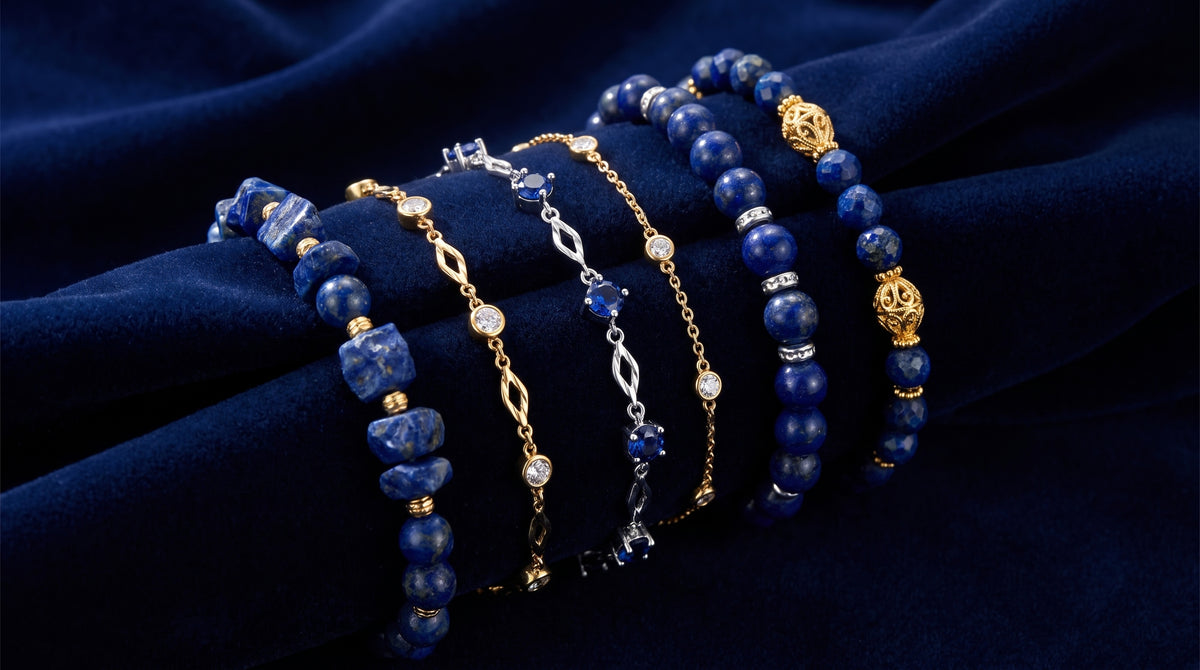
Search for a September birthstone bracelet and the results pull in two directions at once. One half of the page shows deep blue sapphire. The other half shows lapis lazuli, a denser, more opaque blue scattered with gold-colored pyrite flecks. Shoppers reasonably assume one of them is a mistake. Neither is. The split traces back to a naming problem: the ancient term sapphirus, praised by classical writers as a blue stone "dusted with gold," describes lapis lazuli, not the corundum we call sapphire today. Pliny the Elder's gold-flecked description simply does not match corundum. Sapphire only became September's official stone when the 1912 Jewelers of America list standardized the modern birthstone calendar, and lapis was later restored alongside it on the United Kingdom's 2013 birthstone list.
That history matters when you are buying, because the two stones behave completely differently on a wrist. One is the second-hardest gem material in common jewelry use. The other is a soft, layered rock that objects to perfume, chlorine and ultrasonic cleaners. This guide separates the two clearly, shows which Awareness Avenue bracelets genuinely qualify as September pieces, which are simply good companions in a stack, and how to match the stone to how you actually live.
Two blue stones, one month: what actually counts
A bracelet earns the "September birthstone" label if it features sapphire or lapis lazuli. Anything else is a color match, not a birthstone.
Sapphire: the modern standard
Sapphire is corundum, a single mineral that measures 9 on the Mohs hardness scale — directly below diamond and far above most colored stones used in everyday jewelry. That hardness is why sapphire has long been used in engagement rings and heirloom pieces: it resists scratching under daily wear and tends to keep its polish for decades. Blue is the canonical birthstone hue, but corundum also occurs in yellow, white, purple and the pink-orange variety known as padparadscha, so "sapphire jewelry" is not automatically blue.
Symbolically, blue sapphire has been tied to wisdom, loyalty and truth for centuries. Medieval clergy wore it as a signal of heaven-minded judgment, and Persian lore imagined the sky as the reflection of an enormous sapphire. Those associations are cultural traditions rather than proven effects, but they are a genuine part of why the stone is chosen for commitment jewelry and milestone gifts.
When jewelers grade fine sapphire, they look at color, clarity, cut, carat weight and origin, with certain origins carrying a premium. Prices for gem-quality material climb very steeply as color and clarity improve, which is why finished sapphire pieces range from accessible fashion jewelry to serious investment territory. Judge any specific bracelet by what its own product page states about the stone, not by the word "sapphire" alone.
Lapis lazuli: the older claim
Lapis lazuli is not a single mineral at all. It is a rock, composed mainly of lazurite with calcite and pyrite mixed in — which is exactly why it shows those gold-colored metallic flecks and occasional white veining. It has been mined in the Badakhshan province of Afghanistan for more than 6,000 years, predating sapphire's rise as a luxury gem by millennia. Cleopatra is said to have ground it into eye shadow, and it appears throughout ancient Egyptian and Mesopotamian ornament.
Because it is a composite rock rather than a hard single crystal, lapis is considerably softer and more chemically sensitive than sapphire. Traditional meanings attached to it — inner peace, mental clarity and honest communication — overlap neatly with sapphire's themes of wisdom and truth, which is part of why the dual-stone arrangement for September holds together rather than feeling arbitrary. In modern crystal practice, lapis is associated with the throat and third-eye centers; treat that as symbolism, not a medical or psychological claim.
If you are shopping lapis specifically, the quality markers are worth knowing: look for an even, saturated deep blue; small pyrite flecks scattered evenly rather than clumped; a smooth high polish; and minimal white calcite dominating the surface. Heavily calcite-streaked material reads gray-blue and looks chalky next to a well-selected strand.
Iolite, carnelian and other unofficial alternates
You will occasionally see iolite offered as a September stone. It is a violet-blue gem nicknamed "water sapphire" and appears in some crystal traditions as a lower-cost way to get the month's color. Carnelian also turns up in a few jewelry blogs as a September association. Neither carries the standing that sapphire and lapis do on mainstream birthstone lists, so treat them as aesthetic or metaphysical alternatives — pleasant, but not what most gift recipients will expect.
Sapphire vs lapis lazuli: durability and care compared
This is the single most useful comparison for a bracelet, because wrists take more knocks than ears or necklines. A bracelet grazes desks, door frames, car doors, gym equipment and sink edges all day.
| Factor | Sapphire | Lapis lazuli |
|---|---|---|
| Material | Corundum, a single mineral | A rock: lazurite with calcite and pyrite |
| Hardness | 9 on the Mohs scale, just below diamond | Notably softer; scratches and abrades more easily |
| Best use | Daily-wear and heirloom pieces | Statement, artistic and mindful-wear pieces |
| Ultrasonic cleaning | Generally safe unless the stone has significant fractures or fluid inclusions | Never — ultrasonic and steam cleaning should be avoided |
| Routine cleaning | Warm soapy water and a soft brush | Wipe gently with a dry, soft cloth |
| Main hazards | Scratching softer stones stored beside it | Chemicals, perfume, prolonged water exposure, extended direct sunlight |
Caring for a sapphire bracelet
Warm water, a drop of mild soap and a soft brush handle most buildup. Because sapphire is harder than nearly everything else in a jewelry box, the risk runs the other way: store it separately so it does not scratch softer stones or polished metal. If a sapphire piece has visible fractures or heavy inclusions, skip ultrasonic cleaning and stick to hand washing.
Caring for a lapis bracelet
Put lapis on last, after lotion, perfume and hairspray, and take it off before swimming, showering or cleaning. No ultrasonic machine, no steam, no chemical dips. Wipe it with a dry soft cloth and rest it in a soft pouch away from harder gems. Prolonged direct sunlight can dull the color over time, so avoid leaving it on a sunny windowsill. None of this makes lapis fragile in normal use — it simply means it rewards a little intention, which suits a stone associated with clarity and taking stock.
The Awareness Avenue September bracelet lineup
Two stone families in our bracelet collection map directly onto September: one simulated sapphire design in sterling silver, and a group of natural lapis lazuli bracelets.
September Sapphire Birthstone Bracelet — S925 sterling silver

The September Sapphire Birthstone Bracelet is the most literal answer to the query: sterling silver (S925) with a September birthstone in sapphire blue. Be clear on stone type before you buy — it sits within our September simulated sapphire collection, meaning the blue stone is a simulant chosen for the birthstone color rather than mined or lab-grown corundum. That is the honest framing: this is a birthstone-color gift piece in a real precious metal, not a fine gemstone purchase, and it is priced and built for that role. For anyone shopping a September birthday gift, a coordinated sterling silver birthstone set, or a first birthstone piece for a younger recipient, that trade-off is usually the right one. Check the product page for current length and stone specifications before ordering.
Natural lapis lazuli: the Astra and Azure bracelets
If you want a real, mined September stone with visible character, lapis is the accessible route. The Astra Natural Lapis Bracelet is a beaded design built from natural lapis, which makes it the closest match to the beaded birthstone bracelets that dominate this category elsewhere — easy to layer, easy to wear with silver or gold, and softer on the wrist than a rigid cuff.
The Azure family gives you variations on the same stone so you can pick by mood rather than by month alone: Azure Drift, Azure Glow, Azure Melody, Azure Orbit, Azure Trace and Azure Whisper. Because lapis is a natural rock, expect variation between pieces in the exact pattern of pyrite flecking and calcite veining; that variation is a sign of genuine material, not a flaw. Browse the full lapis lazuli collection if you want to compare the designs side by side.
Two bracelets that are not birthstone pieces — but belong in the stack
Honesty is more useful than an inflated roundup. The Nerienne Station Bracelet in solid gold and The Caelisse Bolo Bracelet in S925 sterling silver are not September birthstone bracelets — neither is built around sapphire or lapis. They earn their place here for a different reason: a birthstone bracelet almost always looks better with a plain metal partner. The Nerienne's evenly spaced stations add rhythm without competing with a blue stone, and the Caelisse bolo's sliding closure means it adapts to the wrist rather than requiring an exact length, which is genuinely handy when you are gifting and do not know someone's measurement. See the rest of the solid gold pieces if you want the fine jewelry route.
Reading the stone label: natural, lab-grown, or simulated
This is where most birthstone bracelet disappointment originates, and it is easy to avoid.
Natural sapphire
Mined corundum. Graded on color, clarity, cut, carat and sometimes origin. The most expensive option by a wide margin at gem quality, and the one that behaves exactly as described above at Mohs 9.
Lab-grown sapphire
Chemically the same corundum, grown in controlled conditions. It delivers sapphire's appearance and hardness at a substantially lower price, which is why it has become a common choice in contemporary birthstone jewelry. It is a real sapphire by material — the difference is origin, not durability.
Simulated sapphire
A stand-in material set to give the sapphire-blue look. It is not corundum and should not be assumed to share corundum's hardness. There is nothing wrong with a simulant in a birthstone gift piece, provided the listing says so plainly — as ours does. What you should never accept is a listing that says only "sapphire" and leaves you guessing.
Birthstone tradition itself has never required a mined stone, so a lab-grown or simulated September bracelet is still a September bracelet. The requirement is disclosure, not origin.
Style, fit and stacking
The four common constructions
Beaded bracelets string the stone as the body of the piece or as a focal bead among metal beads; this is the dominant format in the wider birthstone market (seen in options like a mint and lily birthstone bracelet), and brands frequently describe beaded birthstone bracelets as designed for stacking or wearing solo. Station bracelets space small motifs along a fine chain for a quieter, more polished look. Charm bracelets hang the birthstone as a drop — a pandora birthstone bracelet from their September gift set, for instance, pairs a sterling silver sliding bracelet with a birthstone-colored infinity charm. Bolo bracelets use a sliding closure so the fit adjusts on the wrist.
Getting the fit right
Measure the wrist with a strip of paper or a length of string, mark where it meets, then lay it flat against a ruler. Add roughly a half inch for a close fit and closer to a full inch for a relaxed drape. Beaded designs are less forgiving than chain, because a bead strand cannot be shortened by moving a clasp. If you are buying as a surprise and cannot measure, the adjustable bolo format removes the guesswork entirely. Our product pages carry sizing guidance, and support can help if you are between sizes.
Building a September stack
Three rules do most of the work. Vary the scale — one beaded lapis piece, one fine chain, one plain band. Keep metal tones deliberate rather than accidental; mixed metals look intentional when at least two pieces repeat the same tone. And put the softer stone where it takes fewer hits: if you wear a watch, stack lapis on the opposite wrist, since a case and clasp will abrade it faster than anything else you own. For a broader look at formats by month and metal, our birthstone bracelet guide covers the full calendar.
Gifting: coordinating pieces and multi-stone requests
Matching a bracelet to other september birthstone jewelry
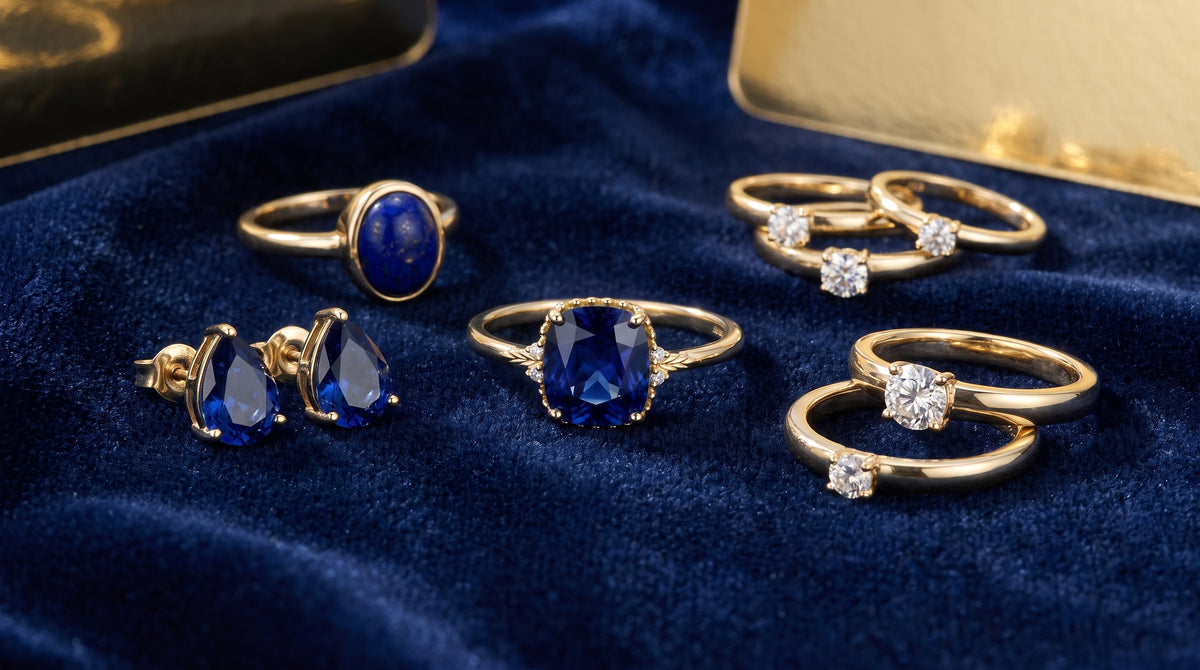
Coordinated sets are a large part of how this category is sold — brands routinely bundle a bracelet with matching earrings or a september birthstone necklace for birthday gifting. If you are building a set rather than buying a bundle, match the metal first and the stone treatment second: a simulated sapphire bracelet pairs naturally with simulated sapphire studs, while natural lapis reads best next to other natural stone. If a ring is on the list instead, our guide to the September birthstone ring in gold walks through vermeil versus solid gold for the same stone.
If you actually want multiple birthstones
Plenty of people searching for a September bracelet are really shopping for a mother's piece with several stones on it — one per child, or one each for a couple. Several personalization-led brands build exactly that, letting you mix stones by month, color or meaning across a single bracelet. Our bracelets are fixed designs rather than a build-your-own configurator, so the equivalent here is stacking: a September piece worn beside another month's bracelet reads the same story with more flexibility to add to it later. If a true custom birthstone bracelet is the goal, start with our guides to the best 2 birthstone bracelet for mom and personalized birthstone bracelets, which cover stone count, layout and setting choices in detail. The rest of our month-by-month options live in the birthstone jewelry collection.
How to choose in under a minute
- You want the textbook-correct September stone: choose sapphire. It is the modern standard and the one most recipients expect.
- You want a real mined stone with visible character, and you like blue with gold flecks: choose natural lapis lazuli, and accept gentler care.
- The bracelet will never come off — gym, dishes, sleep: sapphire, and preferably natural or lab-grown corundum rather than a simulant.
- You are gifting without a wrist measurement: choose an adjustable bolo, or pair a birthstone piece with an adjustable one.
- You are building a layered look over time: start with one plain metal bracelet and add the September stone beside it.
Frequently asked questions
Is lapis lazuli really a September birthstone?
Yes, as a recognized alternative. Sapphire is the primary modern stone, fixed by the 1912 Jewelers of America list, while lapis was formally paired with sapphire for September on the United Kingdom's 2013 birthstone list — and the ancient "sapphirus" that classical writers described was almost certainly lapis in the first place.
Can I wear a lapis bracelet in the shower or pool?
No. Keep lapis away from prolonged water exposure, chlorine, perfume and cleaning chemicals, and never put it through an ultrasonic or steam cleaner. Wipe it with a dry soft cloth instead.
Does a simulated sapphire bracelet still count as a birthstone gift?
It does. Birthstone tradition is about the month and the stone's identity, not about mining origin. What matters is that the seller states clearly which it is, so you know what you are buying and how to care for it.
Which is better for everyday wear, sapphire or lapis?
Sapphire, by a wide margin, when it is genuine corundum — at Mohs 9 it tolerates daily wear that would gradually dull lapis. Lapis is better suited to considered, occasional wear or to a stack that stays off the wrist during rough activity.
Sterling silver or gold for a September bracelet?
Both work with blue. Silver keeps sapphire and lapis cool and crisp; yellow gold warms them and picks up the pyrite flecks in lapis especially well. If you are weighing metals seriously, our 14k gold birthstone bracelet guide compares karats, plating and solid gold for exactly this decision.

Leave a comment
This site is protected by hCaptcha and the hCaptcha Privacy Policy and Terms of Service apply.