


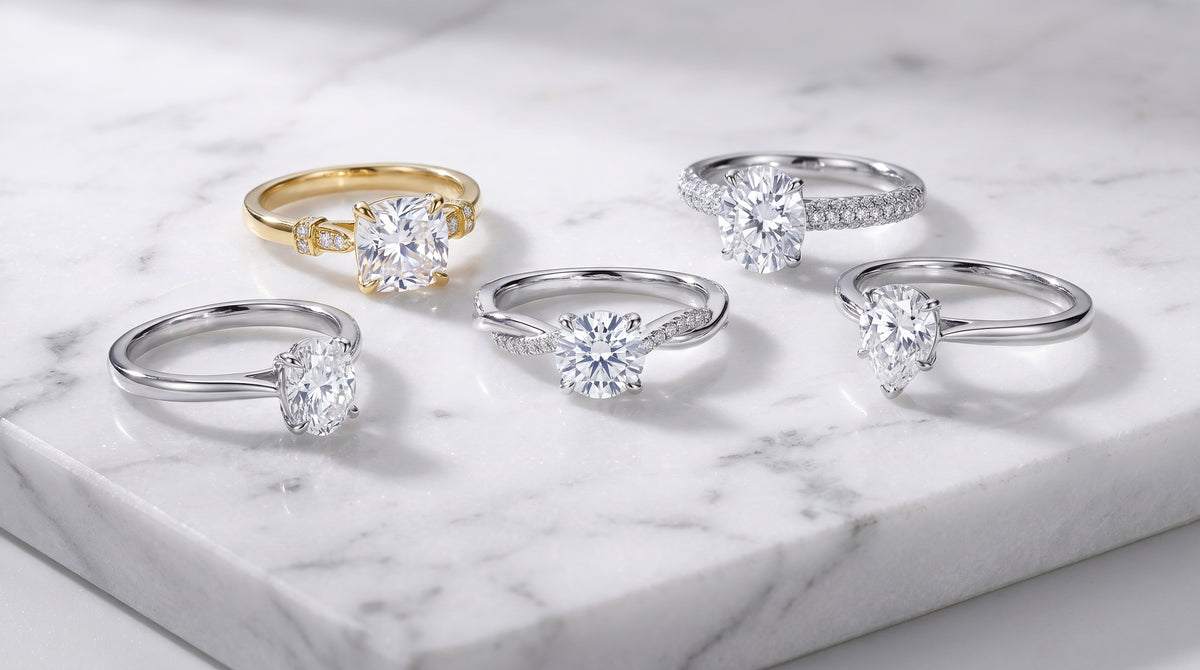
Search for a sterling silver moissanite band and you will notice something quickly: almost nothing that surfaces is a plain solitaire. The category is dominated by eternity and half-eternity designs, stackers, and five- or three-stone wedding bands, and retailers describe them in a very consistent way. One mass-market retailer, for example, lists two near-identical sterling silver moissanite eternity bands side by side, one with 17 round-cut stones and a stated total of roughly 1.06 carats, the other with 20 stones and a stated 2.5 carats, both at the same 15.7 mm product diameter. Those are vendor-reported figures for two specific items, not industry averages, but they illustrate the real decision most shoppers face: the metal is settled, so the choice comes down to stone size, coverage around the finger, setting style, and how much upkeep you are willing to do.
This guide covers all four. It explains what the “925” stamp actually changes about a band's mechanical behavior, why moissanite does not cloud or tarnish while its silver setting can, which Awareness Avenue band shapes suit which purpose, and the short maintenance routine that keeps a silver band looking newly polished for years.
How to read a sterling silver moissanite band spec sheet
Band listings compress a lot into a few lines. Knowing which numbers matter—and which are marketing shorthand—makes comparison much faster.
Stone count, carat weight, and coverage
Two bands with the same total carat weight can look completely different. A half-eternity band concentrates its stones across the top half of the finger, so each stone can be larger for the same total weight, while a full eternity band spreads the same weight around the entire circumference in smaller increments. Full coverage sparkles from every angle and looks identical no matter how the ring rotates; half coverage keeps the underside smooth, which many people prefer for comfort and for stacking against another ring. Where a total carat figure is quoted, treat it as the seller's own stated specification for that specific design rather than a measured, transferable standard.
Setting type: channel, prong, and pave
Setting style affects both look and protection. Channel settings sink stones between two metal walls so the girdles are shielded from knocks. Prong and micro-pave settings lift more of each stone into the light, which increases visible sparkle but leaves slightly more surface exposed. Well-crafted sterling silver takes precise prong, bezel, and channel work, and thoughtfully designed settings help protect stone edges from accidental impact while holding stones firmly in place. If your band will be worn daily alongside another ring, channel or low-profile pave generally holds up best against metal-on-metal rubbing.
Plating and finish
Many silver bands are finished with rhodium or a platinum-tone plating. Plating gives a bright white sheen and reduces how quickly tarnish becomes visible, but it is a surface layer: it wears at contact points over time and needs periodic reapplication. Plating can also slightly alter color and fine surface detail. None of this is a defect—it is simply a maintenance schedule you should know about before you buy, especially for a band worn every day.
Width and profile
Width is the most underrated spec. A 1.5–2 mm band disappears into a stack; a 3 mm or wider band reads as a statement piece on its own and takes up more finger space, which matters if you plan to wear it flush against an engagement ring. Comfort-fit or rounded interiors feel better on wider bands.
Why moissanite and 925 silver work together—and where they differ
The pairing makes sense once you separate what each material does.
Moissanite: hard, bright, and chemically stable
Moissanite used in jewelry is silicon carbide. It is reported at roughly 9.25 on the Mohs hardness scale and with a refractive index around 2.65, which is why it returns so much light and resists the surface scratching that dulls softer stones. Its crystal structure is thermodynamically stable at room temperature, with no ordinary chemical pathway for internal degradation, so moissanite does not fade, haze, or tarnish—tarnishing is a reaction that affects reactive metals such as silver, copper, and brass, not a stable crystalline gemstone.
That matters for expectation-setting. When a moissanite band looks dull, the cause is almost always surface film—skin oils, hand cream, soap residue, shampoo and conditioner—sitting on the stone and muting its light performance, or tarnish on the metal making the whole ring read darker. Both are reversible with cleaning. Internal cloudiness in moissanite is very rare.
925 sterling silver: the alloy does the heavy lifting
Sterling silver is 92.5% pure silver with 7.5% other metals, most commonly copper. That small alloy fraction is the entire point: it raises hardness and tensile strength so edges hold and settings resist deformation in everyday wear. Fine silver bends and dents easily; 925 keeps its shape under knocks and repeated flexing, which is what a ring shank experiences every time you take it on and off. Sterling silver is also described as strong, corrosion-resistant, and hypoallergenic, and it holds stones securely in properly executed settings—which is why it is a legitimate band metal rather than a compromise.
What tarnish is, and what it is not
Tarnish forms when surface silver reacts with sulfur compounds in the air to create silver sulfide, darkening the finish. It is a surface phenomenon. It does not indicate structural failure, it does not weaken prongs, and it polishes off. Gold alloys can also tarnish depending on composition, though often less than sterling silver; platinum does not tarnish but can develop a slight patina that polishes back to a bright finish. The honest summary for silver is this: mechanically capable of daily wear, visually dependent on a little routine care. If you want to go deeper on the alloy side, our 925 sterling silver moissanite engagement ring guide covers durability and setting choices in more detail.
Sterling silver moissanite band styles worth comparing
Below are the band shapes that answer this search, matched to how people actually wear them. Where a design's metal is confirmed as S925 sterling silver in the product listing, that is noted; where it is not, check the product page before ordering if sterling silver is a firm requirement.
Half-eternity pave stacker: Twist Pavé 1CT Round Cut
The Twist Pavé 1CT Round Cut Moissanite Ring is listed in S925 sterling silver and is the most versatile shape in this roundup: a slim pave line with a twisted silhouette that reads as continuous sparkle from the top while keeping a light profile. This is the band to choose if you want one piece that can work as a wedding band, sit beside a solitaire, or be worn alone on the right hand. The twist also helps a slender band look substantial without adding width.
Twisted band with a defined center: Twisted Band 1CT Round Cut
The Twisted Band 1CT Round Cut Moissanite Ring pairs a crossover shank with a focal round stone, which gives you a band that still has a clear front. It suits anyone who finds a full eternity too uniform but wants more presence than a plain metal ring. Because the shank crosses rather than running straight, it nests well against a matching curved band. If you are weighing this silhouette against a plain solitaire shank, our comparison of solitaire versus twisted band moissanite rings breaks down the trade-offs in wear and stacking.
Full-coverage sparkle: 4CT Radiant Cut Moissanite Eternity Ring
The 4CT Radiant Cut Moissanite Eternity Ring is the maximum-impact option here: radiant-cut stones set around the band so light returns from every angle. Radiant cuts read broader than rounds of comparable size, so a radiant eternity band covers more visual surface. Two practical notes for any full eternity design: stones run the whole circumference, so sizing has to be right at the point of purchase rather than adjusted later, and a fully set band will rub against a neighboring ring, so consider whether you will wear it alone or with a spacer.
Three-stone bands: The Lily and the Vintage 3-Stone
Three-stone designs sit between a band and a center-stone ring, with the stones spread across the top of the finger. The Vintage 3-Stone Round Cut Moissanite Ring is listed in S925 sterling silver and leans traditional, while The Lily offers the same three-stone layout in a cleaner line. Both are popular as anniversary or milestone bands because the trio is easy to read symbolically, and both keep a lower profile than a raised solitaire, which helps if you work with your hands.
Everyday silver band: The Camilla
The Camilla S925 Silver Moissanite Ring is explicitly listed in S925 silver and is the straightforward pick when you want a moissanite band for constant wear rather than a bridal statement—the kind of ring you stop noticing you have on. It is also an easy entry point if you are testing whether silver's maintenance rhythm suits your habits before committing to a full eternity design.
Bands that partner a center-stone ring
If you are shopping for a band to sit with an engagement ring, look at the center ring's profile first. The Ethereal and The Opaline 3CT Marquise Cut Pavé Solitaire are center-stone designs rather than bands, and both benefit from a slim, low pave band that tucks under the setting. The Forevermore arrives as a coordinated halo set, which removes the guesswork about how the two pieces meet. And if you like a two-tone look, The Alina is listed in gold and can be mixed deliberately with a silver band—just expect the two metals to wear and be polished on different schedules. You can browse the full range in the silver moissanite rings and moissanite rings collections, and our sterling silver moissanite ring set guide covers matching a band to a center ring in more detail.
Choosing stone quality, size, and fit
Color and clarity
Buying guides for silver-set moissanite consistently recommend D-color or near-colorless stones with high clarity—VVS1 is the commonly cited target—for the brightest appearance. This matters more in silver than in yellow gold, because a white metal gives no warm cast to disguise any tint in the stone. If a listing does not state color and clarity, ask.
Getting the size right
Measure at the end of the day, when fingers are at their largest, and measure the finger you will actually wear the ring on. The simple method: wrap a thin strip of paper or a length of string around the base of the finger, mark where it meets, measure that length in millimeters, and match the circumference to a size chart. Cross-check by measuring the inside diameter of a ring that already fits. For fully set eternity bands, err toward accuracy rather than assuming later adjustment is available, and remember that a wider band feels tighter than a narrow one at the same nominal size.
Match the design to your hands
If you lift, garden, type all day, or wear gloves, favor channel settings, rounded edges, and lower profiles. If the band is for occasions, a higher-set pave or a broader radiant eternity will read brighter in photographs and under evening light.
The care routine that keeps 925 and moissanite bright
Care for a sterling silver moissanite band splits cleanly into two tasks: remove film from the stones, and manage surface tarnish on the metal.
Weekly clean
Soak the band briefly in warm water with a little mild dish soap, brush gently with a soft toothbrush—paying attention to the underside of the stones, where light enters—rinse thoroughly, and dry completely with a soft, lint-free cloth. This is the routine recommended across moissanite care guides, and it is usually all that is needed to bring back sparkle that seemed to have faded. A soft silver polishing cloth handles light tarnish on the metal between cleans.
What to keep away from it
Avoid bleach, chlorine, acetone, and household cleaners, which can pit or discolor silver over time, and skip abrasive home remedies such as toothpaste, baking soda pastes, and abrasive powders, which scratch metal and can thin plating. Perfume and hairspray leave films; put jewelry on last. Water itself will not damage or cloud moissanite, but soap and product residue will build up on the stone, so a band worn in the shower needs cleaning more often.
Storage and wear habits
Store the band in a cloth pouch or an anti-tarnish box rather than open air, keep it away from heavy manual work, and note that regular wear actually helps slow visible tarnish. For deeper cleaning options and step-by-step method, see our guide on how to clean S925 sterling silver jewelry. If the plating on a rhodium- or platinum-finished band eventually wears at the contact points, professional re-plating restores the bright white surface.
Sterling silver, white gold, or platinum for a band?
The honest trade-off looks like this. Sterling silver gives you a strong, hypoallergenic, white-metal band at the lowest initial cost of the three, with a maintenance requirement: periodic polishing, mindful storage, and occasional re-plating if the finish is plated. White gold reduces how often you think about tarnish and carries higher perceived prestige, at a higher price, though gold alloys can still react depending on composition and white gold is itself usually rhodium-plated. Platinum does not tarnish and is highly durable, developing only a slight patina that polishes back easily—the lowest-maintenance and highest-cost option.
A useful way to decide: if the band will live on your finger every day for decades and you dislike upkeep, the extra spend on a harder-wearing white metal buys you fewer chores. If you rotate rings, like refreshing your stack, or want to allocate more of your budget to stone size and design quality, sterling silver is a genuinely sound band metal—its 92.5% alloy exists precisely to make silver wearable. Notably, the moissanite will almost certainly outlast whichever setting you choose, so a stone can be reset into a new band later if you ever want to change metals. For a fuller side-by-side, read how to choose between sterling silver and white gold moissanite rings.
Common questions about sterling silver moissanite bands
Will the moissanite get cloudy over time?
No. Moissanite's silicon carbide structure is stable at room temperature, and it does not fade, haze, or tarnish. Apparent cloudiness is surface buildup—oils, lotion, soap film—which washes off with warm water and mild dish soap. If a clean stone still looks dull, check the metal: a tarnished silver band darkens the whole ring's appearance.
Is sterling silver strong enough for a wedding band?
Mechanically, yes. The 7.5% alloy content in 925 silver raises hardness and tensile strength so shanks and settings hold their shape through everyday knocks and flexing, and well-made silver settings hold stones securely. The realistic caveat is cosmetic rather than structural: silver tarnishes and plated finishes wear, so plan on light routine care.
Does tarnish damage the ring?
Tarnish is silver sulfide forming on the surface. It darkens the finish; it does not signal structural failure and it comes off with a polishing cloth or a gentle clean. It affects the band, not the moissanite.
Can I wear it in the shower or swimming?
Water will not harm moissanite, but chlorine and bleach can pit or discolor silver over time, so remove the band before pools and hot tubs. Shower products also leave residue that mutes sparkle, so if you shower in it, clean it more frequently.
Full eternity or half eternity?
Choose full eternity for uninterrupted sparkle and symmetry with no “front,” accepting that sizing must be right up front and the band will contact any ring worn beside it. Choose half eternity for a smooth, comfortable underside, easier stacking, and larger-looking stones for the same total weight.
How often should I polish it?
Rather than a fixed schedule, work to a trigger: a quick soapy clean whenever the stones look less lively, and a pass with a silver cloth as soon as the metal starts to look gray at the edges. Frequent wearers usually find this is a few minutes every couple of weeks; occasional wearers mostly need it after storage.
The short version
A sterling silver moissanite band is a strong everyday choice when you understand the division of labor: the moissanite supplies hardness (about 9.25 Mohs), high light return (refractive index around 2.65), and long-term stability, while the 92.5% silver alloy supplies a secure, comfortable, hypoallergenic frame that needs periodic polishing and, if plated, occasional refinishing. Decide your coverage first—full eternity for all-around sparkle, half eternity or a twisted pave line for stacking, three-stone for a milestone piece—then confirm color and clarity, get the size right, and set up a five-minute cleaning habit. Do those four things and the band will look the way it did the day you got it for a very long time.

Leave a comment
This site is protected by hCaptcha and the hCaptcha Privacy Policy and Terms of Service apply.